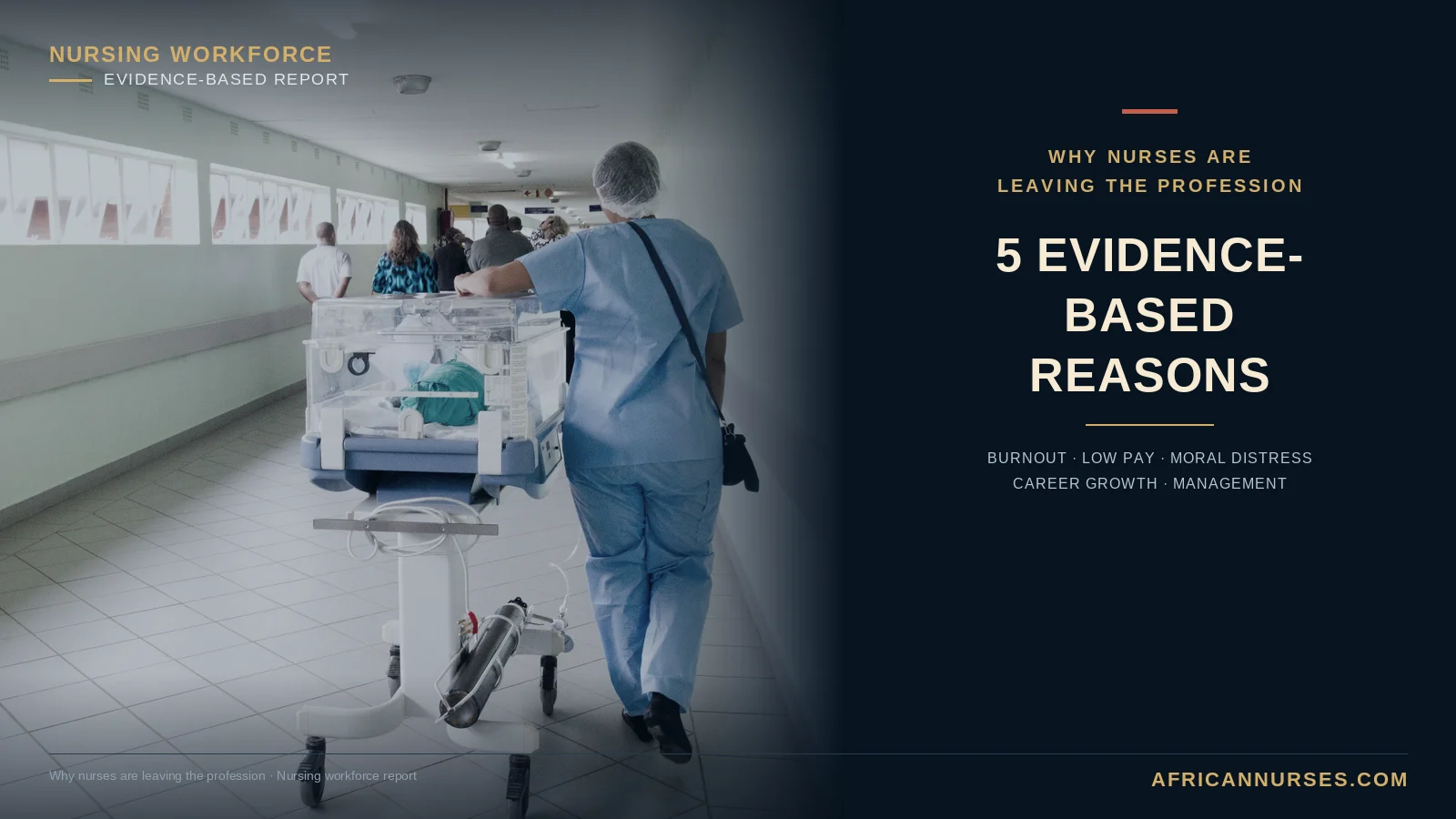

Nursing Retention in Africa: Could Flexibility Keep More Nurses at the Bedside?

Abdullahi Suleiman
September 18, 2026
A nurse can love caring for patients and still want a life beyond the hospital. In this article, you will read about Nursing Retention in Africa: Could Flexibility Keep More Nurses at the Bedside?
They may want to teach, pursue further education, build a business, conduct research or explore another area of healthcare. But when bedside nursing is built around long shifts, rotating schedules and heavy workloads, pursuing those things can become difficult.
Eventually, leaving the bedside can start to feel like the easiest way to create room for them.
Are nurses leaving the bedside because they don’t want to care for patients, or because the way bedside nursing is structured leaves too little room for the rest of their lives and careers?
READ ALSO: Why nurses are leaving the profession
The question matters because Africa cannot afford to casually lose nurses from the bedside.
The World Health Organization’s Regional Office for Africa reported about 1.7 million practising nursing personnel across the continent in 2024, with a nursing density of roughly 15 nurses per 10,000 people, far below the estimated need of 56.73 per 10,000.
Yet the challenge is not simply about how many nurses Africa trains. The continent is also grappling with unemployment, migration, retention and the uneven distribution of its health workforce.
So perhaps we should ask a different question:
How do we make bedside nursing a career nurses can sustainably stay in?
Table of Contents
- The problem may not be nursing. It may be how nursing works.
- What if nurses didn’t have to choose?
- Flexibility could make the bedside more sustainable
- Career growth shouldn’t require leaving the bedside
- But flexibility must be designed carefully
- Conclusion: Africa cannot afford to lose nurses unnecessarily
- References
The problem may not be nursing. It may be how nursing works.
Bedside nursing can be demanding anywhere, but in many African settings, nurses work within systems characterised by long shifts, heavy workloads, staffing shortages and limited flexibility.
In Nigeria, for example, studies have documented nurses working 8–12-hour shifts across several days or nights each week. Rotating shifts have also been associated with sleep deprivation, fatigue, stress and limited time for health-promoting activities.
Another Nigerian study found an average working week of more than 48 hours among nurses surveyed, alongside frequent night duties and significant levels of burnout.
When work consumes most of your time and energy, pursuing anything else becomes difficult. Furthering education, building a business, exploring research and teaching becomes harder.
Even having enough time to rest and care for family becomes harder. And eventually, a nurse may begin looking for a different way to practise. Not necessarily because they have stopped caring about patients.
But because the bedside, as currently structured, may leave little room for anything else.
What if nurses didn’t have to choose?
This is where flexibility becomes important.
Flexibility in nursing does not simply mean working fewer hours or choosing when to work. It can mean creating different ways for nurses to remain clinically engaged while accommodating different stages of life and career goals.
Imagine a nurse who works three clinical days a week and spends the remaining time teaching. A nurse who combines clinical practice with research. Or another who works part-time at the bedside while building a healthcare business.
A nurse who can reduce clinical hours temporarily while completing a postgraduate programme, then increase them again later. Or even a nurse returning from maternity leave who has access to a structured, flexible pathway back into clinical practice.
These are not necessarily nurses who want to leave nursing.
They are nurses trying to build a career around their lives rather than a life around their shifts. And that distinction matters.
READ ALSO: The risk behind the Nurses Uniform
Flexibility could make the bedside more sustainable
Research from different healthcare settings has linked schedule flexibility and supportive practice environments with nurses’ intentions to stay.
Self-rostering, for instance, has been associated with improved morale and retention. Other research has highlighted the importance of flexible working arrangements, family-friendly policies and supportive workplaces in improving nurses’ work-life balance.
African evidence points in the same direction.
A systematic review of nurse retention in Sub-Saharan Africa identified factors such as working conditions, career progression, supportive leadership, recognition, employment terms and predictable human-resource practices as important to keeping nurses in the workforce.
Flexibility will not solve all of these problems. It cannot compensate for inadequate staffing, poor remuneration or unsafe working environments. But it can be part of a broader strategy to make clinical nursing more sustainable. And perhaps that is the point.
We shouldn’t treat flexibility as a perk when it could be part of workforce retention.
Career growth shouldn’t require leaving the bedside
There is another problem worth considering. Sometimes, the structure of nursing creates an unspoken choice: Stay at the bedside or grow.
Clinical practice is often demanding enough that nurses who want to pursue education, research, leadership, entrepreneurship or other interests may eventually have to reduce or completely stop their clinical work.
But what if we designed careers where these identities could coexist?
A nurse could be a clinician and lecturer. A clinician and researcher. A bedside nurse and healthcare entrepreneur. A clinical nurse who contributes to health policy. A nurse who works in health technology while maintaining a defined amount of clinical practice. The possibilities are endless.
This is not about forcing every nurse to remain at the bedside. Some nurses will discover that their greatest contribution to healthcare is outside direct patient care, and that is perfectly valid.
The goal is to make sure that leaving the bedside is a choice, not the only viable pathway to having a sustainable and fulfilling career.
But flexibility must be designed carefully
Of course, flexibility cannot mean simply giving nurses fewer shifts while leaving the same workload for everyone else.
If poorly implemented, flexible scheduling could worsen staffing gaps, disrupt continuity of care or place additional pressure on colleagues. That is why flexibility needs to be intentional.
Healthcare organisations could explore options such as:
- Part-time clinical contracts
- Predictable and adaptable shift patterns
- Self-rostering where appropriate
- Flexible weekly hours
- Job-sharing arrangements
- Structured pathways combining clinical practice with teaching or research
- Flexible schedules that support further education
- Family-friendly leave and return-to-practice policies
The specific model will differ across countries and institutions. But the principle remains the same:
Give nurses more than one way to build a sustainable clinical career.
Conclusion: Africa cannot afford to lose nurses unnecessarily
The continent needs more nurses. But increasing the number of nurses we train is only one part of the solution.
We also need to ask whether the nurses we already have are able to remain in the roles where their skills are most needed.
The African health workforce challenge is not simply a shortage of trained professionals. It is also a problem of recruitment, employment, retention, distribution and migration.
And if nurses are leaving clinical practice because the work structure is incompatible with the lives and careers they want to build, then retention strategies need to address that reality.
Perhaps we have been asking the wrong question. Instead of asking: “How do we convince nurses to stay at the bedside?” Maybe we should ask: “What would make nurses want to stay?”
Because nurses should not have to choose between caring for patients and having room to grow. They should not have to abandon clinical practice to pursue another professional interest. And they should not have to sacrifice their entire lives to remain committed to patient care.
The future of bedside nursing in Africa may not depend solely on recruiting more nurses. It may also depend on reimagining the conditions under which the nurses we already have can stay.
Read Also: How to prepare for NCLEX
References
Ajayi, D. O., Tanova, C., Bayighomog, S. B., & Akinwande, A. S. (2025). Decent work conditions and Nigerian nurse emigration: The role of burnout and commitment. Acta Psychologica, 259, 105294. https://doi.org/10.1016/j.actpsy.2025.105294
Akinyemi, O. O., et al. (2022). Nurses’ perceptions of quality of work life in private hospitals in Enugu, Nigeria: A qualitative study. BMC Nursing, 21, 352.
Hainey, C. L. (2021). Implementation of a ward staff self-rostering system: Improving morale and retention. Nursing Management, 28(3), 22–27. https://doi.org/10.7748/nm.2021.e1987
Kiptulon EK, Elmadani M, Onchuru MP, Szőllősi A, Zrínyi M, Siket AU. Retaining nurses in Sub-Saharan Africa: A systematic review and meta-analysis. Int J Nurs Sci. 2025 Apr 16;12(3):301-309. doi: 10.1016/j.ijnss.2025.04.004. PMID: 40529463; PMCID: PMC12168464.
Leineweber, C., Chungkham, H. S., Lindqvist, R., Westerlund, H., Runesdotter, S., Alenius, L. S., & Tishelman, C. (2016). Nurses’ practice environment and satisfaction with schedule flexibility is related to intention to leave due to dissatisfaction: A multi-country, multilevel study. International Journal of Nursing Studies, 58, 47–58. https://doi.org/10.1016/j.ijnurstu.2016.02.003
Onyebuchi, C. C., et al. (2020). Perceived facilitators and barriers to Nigerian nurses’ engagement in health promoting behaviors: A socio-ecological model approach. International Journal of Environmental Research and Public Health, 17(7), 2397.
World Health Organization Regional Office for Africa. (2026). State of the health workforce in Africa 2026: Plan, train and retain. WHO Regional Office for Africa.
Zhao, S., Zhang, Z., Duan, X., Shao, Y., Wang, F., Chen, Y., et al. (2024). Resilience and flexibility for clinical nurses: A latent class analysis. Journal of Nursing Management, 2024, 6171305. https://doi.org/10.1155/2024/6171305