How to Prepare for the NCLEX: A Clear, Current 2026 Guide

Abdullahi Suleiman
September 17, 2026
If you are getting ready to sit the NCLEX, you have probably already found dozens of study tips online. Some are useful, while some were written for an older version of the exam. Before you start developing a study plan, you should first understand what the exam really looks like right now, because the NCLEX structure has changed recently.
This matters even more if you trained outside the United States. A nurse educated in Nigeria, Ghana, or Kenya who is preparing for the NCLEX after years away from a US-style exam format will not find much use in generic advice.
This guide explains how to prepare for the NCLEX using the current test plan and recent pass-rate data, so you can build a study plan based on how the exam works today.
Table of Contents
How to Prepare for the NCLEX
Good preparation starts with understanding what you are actually preparing for. The sections below walk you through the current exam format, what the numbers really mean for you, and how to turn that information into a practical study schedule.
Understand the 2026 NCLEX Test Plan First
In April 2026, an updated NCLEX-RN Test Plan published by the National Council of State Boards of Nursing (NCSBN) took effect. It is valid from April 1, 2026, through March 31, 2029.
The NCLEX exam is organised into four major Client Needs categories:
Safe and Effective Care Environment, which is divided into:
- Health Promotion and Maintenance
- Psychosocial Integrity
- Physiological Integrity,
It also places heavy emphasis on clinical judgment. According to the NCSBN, clinical judgment is an ongoing process that uses nursing knowledge to observe and assess a situation, identify what matters most for the client, and generate the best possible evidence-based response.
In clinical judgment, you are not simply asked to remember a fact. You are asked to use that fact correctly, under pressure, in a situation that looks like real practice. For instance, a question might describe a client with several changing symptoms and ask you to decide what to do next, rather than simply asking you to name a condition.
Related: The Nurse Migration “Cheat Sheet”: NGN-NCLEX, CBT, and OSCE Changes in 2026
Understand What the Pass Rate Data Means for You
According to the updated 2026 NCSBN pass rate report, the pass rate for first-time, US-educated RN candidates was 87.3%, which dropped to 53.1% for repeat candidates. This gap of over thirty points tells you that your first attempt matters far more than any single attempt after it. Therefore, it is worth treating your first sitting as the one to prepare for fully, rather than planning to simply try again if it does not go well.
For internationally educated candidates, including many nurses trained across Africa, the pass rate was 50.9%, which dropped to 31.3% for repeat candidates. This does not mean the exam is unfair to internationally educated nurses. Instead, it usually reflects differences in how nursing curricula are structured from country to country, and how much exposure a candidate has had to the exam’s specific question style before sitting it.
Knowing this in advance lets you plan your preparation time accordingly, rather than being surprised later.
Read also: Best Countries Offering Nursing Jobs With Visa Sponsorship In 2026
Build a Study Schedule Around the Content Weighting
Once you understand the stakes, the next step is turning that understanding into an actual plan. Note that the official test plan does not weigh every topic equally, so your study time should not be spread equally either.
According to the official NCSBN test plan breakdown, the test is distributed across the following:
Safe and Effective Care Environment
- Management of Care: 15–21%
- Safety and Infection Prevention and Control: 10–16%
Health Promotion and Maintenance: 6–12%
Psychosocial Integrity: 6–12%
Physiological Integrity
- Basic Care and Comfort: 6–12%
- Pharmacological and Parenteral Therapies: 13–19%
- Reduction of Risk Potential: 9–15%
- Physiological Adaptation: 11–17%
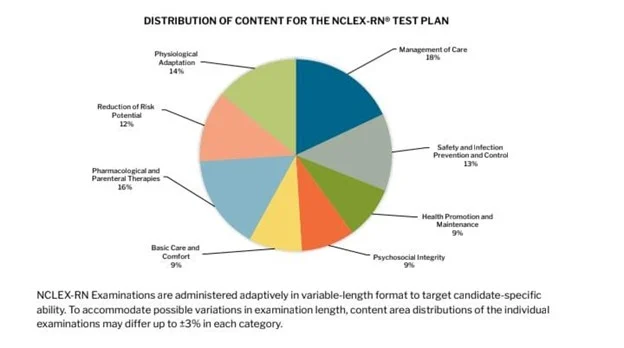
A screenshot of the 2026 updated NCLEX test plan content distribution. Source: the National Council of State Boards of Nursing
From this arrangement, you will see that Management of Care carries the heaviest weight, followed closely by Pharmacological and Parenteral Therapies. Physiological Adaptation, Reduction of Risk Potential, and Safety and Infection Control also carry substantial weight, with Psychosocial Integrity, Health Promotion and Maintenance, and Basic Care and Comfort making up the remaining categories.
Practically, this does not mean you should ignore lower-weighted areas. Instead, your study plan calendar should give the most attention to the highest-weighted categories first, then work down the list.
A common mistake many NCLEX candidates make is to spend equal time on every topic simply because every topic appears somewhere in a textbook. The exam itself does not treat every topic equally, so your study time should not either.
Practise Clinical Judgment, Not Just Recall
With your schedule in place, the final piece is making sure you are practising the right skill, not just the right topics.
Because the current test plan centres on clinical judgment, question banks built entirely around simple recall will only take you half of the way. Therefore, look for practice questions that ask you to:
- Prioritise between several plausible actions,
- Interpret a set of client data, or
- Decide what to do next in an evolving scenario, rather than questions that simply ask you to identify a fact.
- This kind of practice trains the actual skill the exam is measuring, which is different from simply knowing more content.
Here is a list of trusted question bank sources you can try:
Top Premium & Paid QBanks (Most Popular)
- UWorld NCLEX QBank: Maps out all major client needs categories. Its vivid, visual explanations teach the underlying pathophysiology, not just why an option is correct.
- Archer Review Q-Bank: Famous for its high volume of NGN-style questions. It provides unlimited CAT simulator exams and multiple “Readiness Assessments” which track consecutive passing scores to predict success on the real exam.
- Kaplan NCLEX Review: Uses a distinct “Decision Tree” method to break down complex clinical priority questions. It focuses heavily on testing strategies and offers realistic CAT simulations.
- BoardVitals NCLEX-RN: Known for having a highly customizable quiz builder, tough analytical formatting, and a strong pass guarantee.
Top Concept-Based & Supplemental Paid QBanks
- SimpleNursing NCLEX Prep: It is uniquely built around video-enhanced rationales and animated memory tricks, making it the top pick for visual and auditory learners.
- Nurse Plus Academy: Features targeted simulators and client-needs breakdowns, including extensive Select All That Apply (SATA) question blocks, focused heavily on building clinical judgment rather than rote memorization.
Top Free & Reputable QBanks
- Nurseslabs NCLEX Test Bank: Recognized as the best free source for practice questions. Features thousands of questions divided cleanly into specific topics like Pharmacology, Maternity, Med-Surg, and NGN Unfolding Case Studies.
- NCSBN Sample Packs: The National Council of State Boards of Nursing (the makers of the exam) provides official sample items on their page. While it is not a full-length adaptive QBank, it is the only way to interact with the exact wording and software styling of the actual 2026 exam interface.
Related: How To Relocate To Canada as a Nigerian Nurse In 2026: NCLEX Express Entry and the Exact Steps
Common Mistakes That Lower Your Chances
A few patterns show up again and again among candidates who do not pass on their first attempt. Some of these preparation mistakes are easy to avoid once you know what to watch for.
Here is a list of common mistakes that can lower your chances of passing the NCLEX
- Studying mainly from outdated question banks that do not reflect the current clinical judgment format.
- Treating every content area as equally important instead of using the official test plan.
- Practising questions without reviewing why each answer is correct or incorrect.
- Relying mainly on memorised facts instead of practising prioritisation and decision-making.
- Not practising a full-length, timed, computer-adaptive test beforehand.
What to Do in the Final Two Weeks Before Your Exam
During the final two weeks, focus on consolidation rather than trying to learn everything from scratch.
- Review the highest-weighted areas and topics where your practice performance is consistently weak.
- Complete at least one full-length, timed practice session under realistic conditions.
- Continue practising clinical judgment questions rather than switching entirely to passive reading.
- Reduce heavy new-content intake in the final few days and prioritise sleep and rest.
- Confirm your examination details, identification requirements, travel arrangements, and other materials you need for test day.
NCSBN also recommends that candidates review the 2026 Candidate Bulletin and official preparation resources before the examination.
READ ALSO: NCLEX centre in Africa: KENYA vs SOUTH AFRICA, Which one is better
Conclusion
How to prepare for the NCLEX comes down to a few important steps.
First, understand the current test plan and what the exam is actually testing. Use current pass-rate data to understand your candidate group, especially if you are internationally educated. Build your study schedule around the exam’s content weighting. Practise clinical judgment rather than relying only on recall. Finally, use the last two weeks to consolidate your knowledge and prepare for the testing experience.
None of these steps guarantees a pass. But they give you a preparation plan based on how the NCLEX works today rather than advice written for an older version of the exam.