
Nurses’ Uniform in Nigeria: The Official NMCN Rules Every Nurse Should Know in 2026

Africannurses
16/08/2026
Nurses are the unsung heroes of the healthcare sector, providing compassionate care and support to patients in times of need. Beyond their vital roles, nurses’ uniforms serve as a symbol of their profession and an embodiment of their commitment to healing and care. Nurses’ uniform in Nigeria reflects a unique blend of functionality, cultural influences, and professional pride.
Ask any patient to describe a nurse, and the image that comes to mind almost always starts with the uniform: crisp, clean, and instantly recognizable. But in Nigeria, the nurses’ uniform is more than a dress code. It is a regulated professional standard, backed by an official circular from the Nursing and Midwifery Council of Nigeria (NMCN), and it carries decades of history, culture, and meaning behind it.
Many nurses, students, and even hospital administrators are surprised to learn that Nigeria actually has a documented national standard for nurses’ uniform, one that specifies exact colours, sewing styles, footwear, and even a code of conduct around how the uniform should and shouldn’t be worn. This article breaks down that official standard, traces how the nurses uniform in Nigeria has evolved, and answers the questions nurses and nursing students search for most.
Table of Contents
- Quick Answer: What Is the Official Nurses Uniform in Nigeria?
- The History Behind the Nurses Uniform in Nigeria
- The Official NMCN Colour Code for Nurses Uniform in Nigeria
- Approved Nursing Uniform Styles of Sewing
- Footwear, Badges, and Name Tags
- The NMCN Code of Dressing
- Student Nurses Are Included Too
- How the Nurses Uniform in Nigeria Has Evolved in Practice
- Why the Nurses Uniform in Nigeria Matters Beyond Appearance
- Frequently Asked Questions About Nurses Uniform in Nigeria
- Conclusion
Quick Answer: What Is the Official Nurses Uniform in Nigeria?
According to the NMCN, established by Decree No. 89 of 1979, the national nurses uniform in Nigeria follows a four-colour system, gender-specific sewing styles, and a strict code of dressing that applies to every registered nurse, midwife, and student nurse in the country.
The History Behind the Nurses Uniform in Nigeria
The story of the nurses uniform in Nigeria begins with the country’s colonial healthcare system. Early Nigerian nurses wore uniforms modeled closely on their European counterparts: white gowns, aprons, and starched caps that signified cleanliness and clinical discipline.
After independence, as Nigeria’s healthcare system matured and cultural identity became a stronger part of national institutions, the need for a formal, homegrown standard grew. That standard arrived through the NMCN, the statutory body responsible for regulating nursing and midwifery practice in Nigeria. At its 8th General Meeting, held on 15th and 16th November 2001, the Council deliberated extensively on the colour and style of uniform to be worn by various categories of nurses, and issued a circular that remains the reference point for nurses’ uniform in Nigeria today.
The Official NMCN Colour Code for Nurses Uniform in Nigeria
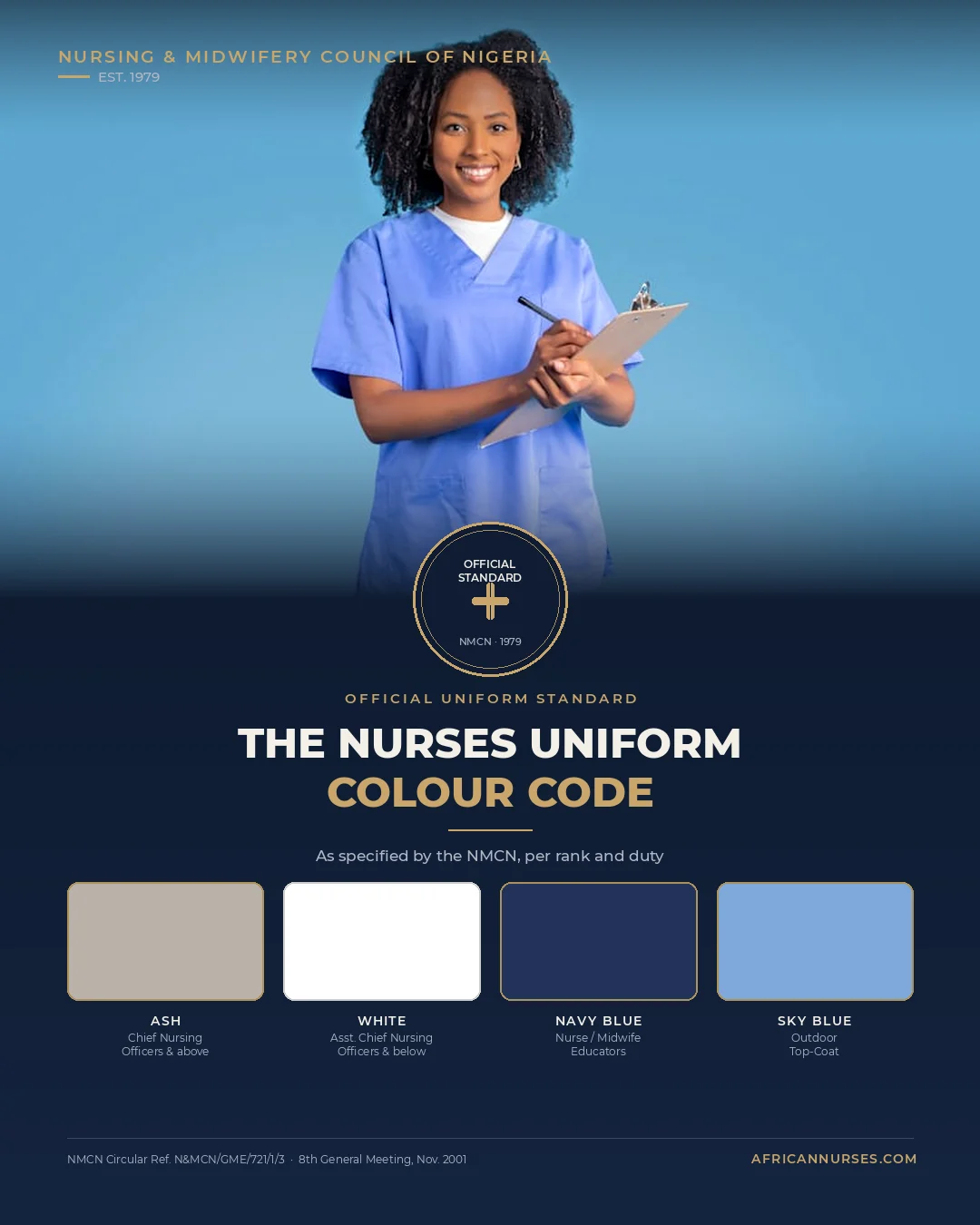
One of the most searched questions among nursing students is simple: what colour uniform am I supposed to wear? The NMCN circular answers this directly, setting out four official colours for the nurses uniform in Nigeria:
- Ash colour — for Chief Nursing Officers and above
- White colour — for Assistant Chief Nursing Officers and below
- Navy blue — for Nurse/Midwife Educators
- Sky blue — as a top-coat for outdoor wear
This colour hierarchy means that, at a glance, seniority and role within a Nigerian healthcare facility can be identified simply by uniform colour — a system designed to bring order, professionalism, and clarity across hospitals, teaching hospitals, federal medical centres, and specialist hospitals nationwide.
Approved Nursing Uniform Styles of Sewing
Beyond colour, the NMCN circular also specifies exactly how the nurses uniform in Nigeria should be sewn, with separate guidance for men and women.
For male nurses, the approved style is a trouser worn with either a short-sleeved or long-sleeved shirt.
For female nurses, three styles are officially recognized:
- A below-knee-length gown
- A below-knee-length skirt and blouse, with short or long sleeves
- A trouser and gown combination, worn with long sleeves
Female nurses are also permitted to wear either a nurse’s cap or a shoulder-length hijab, reflecting an intentional accommodation of religious and cultural diversity within the national uniform standard.
Footwear, Badges, and Name Tags
The regulation of nurses uniform in Nigeria doesn’t stop at clothing. Footwear and identification are equally standardized:
- Shoes: All nurses must wear low-heeled, covered, white or black soft-soled shoes while on duty.
- Badges and name tags: Every nurse must wear an approved badge and name tag at all times while on duty, allowing patients and colleagues to easily identify them.
The NMCN Code of Dressing
Perhaps the most detailed and most debated part of the circular is the official code of dress that governs how nurses present themselves while in uniform. Under this code, nurses are required to observe the following:
- No long nails or nail varnish while on duty
- No dangling earrings, necklaces, or hand jewelry while on duty
- No high hair attachments or weaves extending below shoulder length while on duty
- The uniform must not be worn to beer parlours, open markets, supermarkets, or inappropriate functions
This last point is particularly significant, as it frames the nurses uniform in Nigeria not just as work attire, but as a symbol of professional identity that must be protected even outside the hospital walls.
Student Nurses Are Included Too
The circular doesn’t only apply to registered nurses. Principals of Schools of Nursing, Midwifery, and Post-Basic Nursing Programmes are directed to ensure that student nurses wear:
- Proper school uniform
- Specific school shoes
- Name tags
This means the standard for nurses uniform in Nigeria begins from the very first day of nursing school, instilling professional discipline early in a nurse’s career.
READ ALSO: How to Renew Your Nursing License in Nigeria
How the Nurses Uniform in Nigeria Has Evolved in Practice
While the 2001 NMCN circular remains the formal reference document, real-world practice across Nigerian hospitals has evolved alongside it.
Standardized scrubs: have become an increasingly common contemporary choice. Many healthcare institutions now favour scrubs, a short-sleeved top and matching pants, for their practicality, ease of movement, and comfort, allowing nurses to perform demanding clinical duties efficiently while still maintaining a professional appearance.
Colour-coded departments: have also emerged as an informal extension of the official colour system. Some hospitals use distinct scrub colours to differentiate departments; for example, softer, cheerful tones in paediatric units versus calmer hues in surgical units, helping patients and visitors quickly identify care teams while reinforcing unity among staff.
Cultural accommodation: remains visible too. Beyond the officially permitted hijab, some institutions allow traditional head coverings such as gele-style wraps, provided they align with the broader uniform code, a reflection of Nigeria’s cultural diversity within a standardized profession.
Why the Nurses Uniform in Nigeria Matters Beyond Appearance
For many nurses, the uniform carries meaning that goes far beyond fabric and colour. It represents:
- Professional identity: a visible reminder of the discipline, training, and responsibility that comes with the role
- Patient trust: instantly recognizable attire that reassures patients and their families in vulnerable moments
- Unity and belonging: a shared symbol connecting nurses across hospitals, states, and specialties
As Nigeria’s healthcare workforce continues to grow, the nurses uniform in Nigeria stands as both a regulatory requirement and a visual expression of the compassion, competence, and pride that define the nursing profession.
Frequently Asked Questions About Nurses Uniform in Nigeria
1. Who regulates the nurses uniform in Nigeria? The Nursing and Midwifery Council of Nigeria (NMCN), established by Decree No. 89 of 1979, is the statutory body that regulates the official nurses uniform standard nationwide.
2. What are the official uniform colours for nurses in Nigeria? The NMCN specifies four colours: ash for Chief Nursing Officers and above, white for Assistant Chief Nursing Officers and below, navy blue for Nurse/Midwife Educators, and sky blue as an outdoor top-coat.
3. Can female nurses wear a hijab with their uniform in Nigeria? Yes. The NMCN circular explicitly permits female nurses to wear either a nurse’s cap or a shoulder-length hijab as part of the approved uniform.
4. What shoes are nurses required to wear on duty in Nigeria? Nurses must wear low-heeled, covered, white or black soft-soled shoes while on duty, in line with NMCN regulations.
5. Are student nurses required to follow the same uniform rules? Student nurses have their own uniform requirements set by their nursing schools, including a proper school uniform, specific school shoes, and name tags, as directed by the NMCN.
6. Can nurses wear their uniform outside the hospital in Nigeria? No. The NMCN code of dressing explicitly prohibits wearing the nurses uniform to beer parlours, open markets, supermarkets, or other inappropriate functions.
7. Do all Nigerian hospitals still follow the exact 2001 NMCN uniform standard? The 2001 circular remains the official reference, but many hospitals have adapted it in practice- for example, adopting scrubs for practicality or using colour-coding by department, while staying within the spirit of the NMCN’s guidance.
Read Also: Nursing in Saudi Arabia and UAE
Conclusion
The nurses’ uniform in Nigeria is far more than a dress requirement; it is a nationally regulated standard, rooted in the NMCN’s 2001 circular, that continues to shape how nurses are seen, trusted, and identified across the country’s hospitals. From the ash, white, navy, and sky-blue colour codes to the approved sewing styles, footwear, and strict code of dressing, every detail exists to reinforce professionalism, patient confidence, and unity within the nursing workforce. At the same time, the uniform has room to evolve through scrubs, colour-coded departments, and cultural accommodations like the hijab, proving that tradition and modern practice can coexist. Whether you’re a practicing nurse, a nursing student, or a hospital administrator, understanding these official rules around the nurses’ uniform in Nigeria is essential to upholding the standards of a profession built on trust, care, and pride.
Have you seen the nurses’ uniform evolve at your facility in Nigeria? Share your experience in the comments; your perspective could help shape the conversation on nursing standards across the country.


