
How to Write a Nursing Care Plan: A Step-by-Step Guide for Nurses

Africannurses
15/08/2026
A nursing care plan is a structured framework that directs and guides the specific nursing care a patient will receive throughout their care. Individualized nursing care plans communicate patients’ needs, provide a clear record of the care given, help establish patient-centered goals, and prevent gaps or errors during handover, thereby ensuring continuity of care.
Healthcare practitioners, particularly registered nurses, student nurses, and vocational nurses, rely on nursing care plans. It also supports patients and families in understanding the direction of care.
This article will explain the nursing process, how to write a nursing care plan with examples, common mistakes to avoid, tips for writing effective nursing care plans, and other important considerations.
Table of Contents
OVERVIEW OF NURSING PROCESS
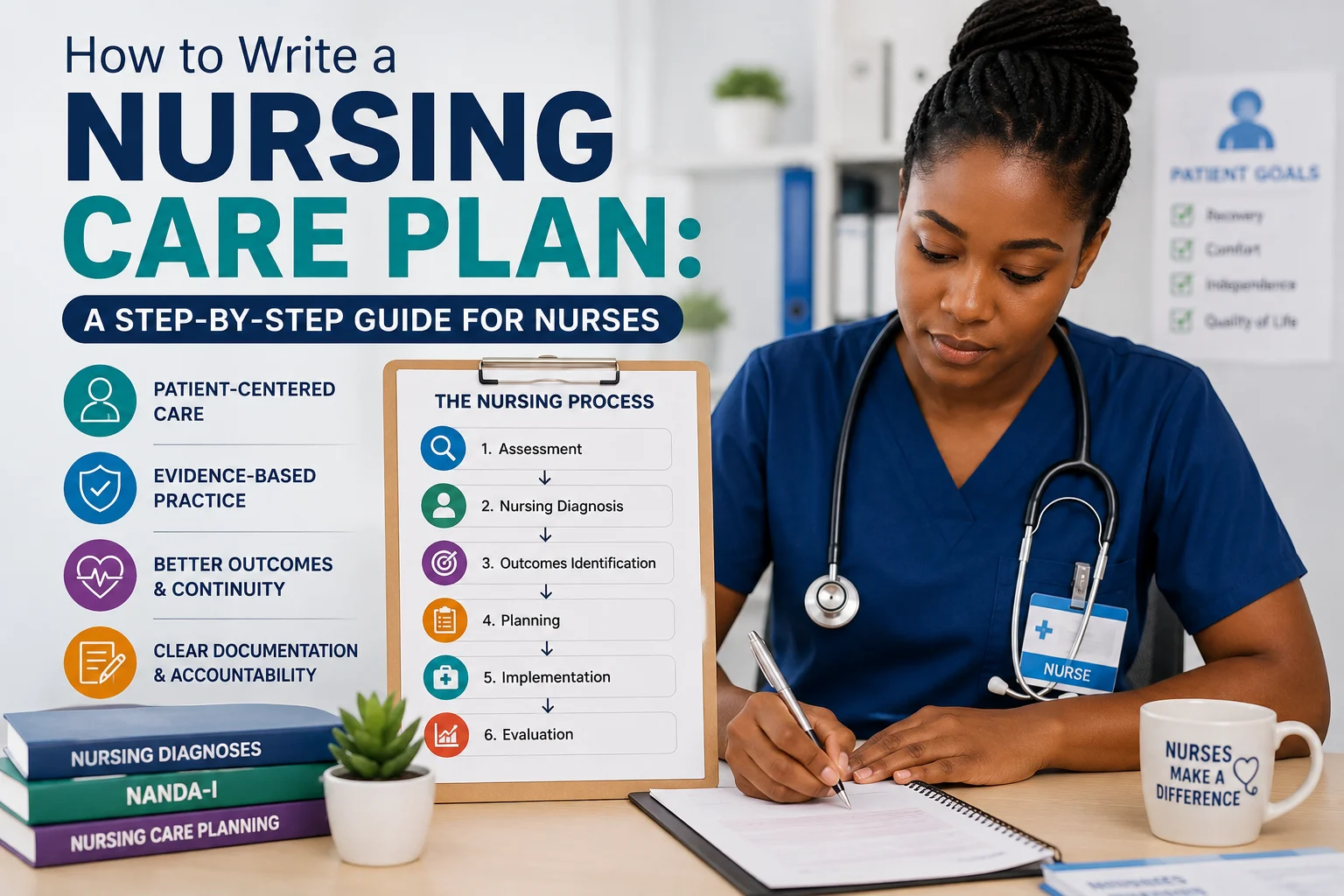
The Nursing Process is a systematic framework of the nursing care plan that guides nurses to deliver consistent, evidence-based patient-centered care. It serves as a critical thinking model that guides clinical reasoning and competent decision-making for all registered nurses. According to the American Nurses Association (2025) Standards of Professional Nursing Practice, the nursing process consists of six standards: Assessment, Diagnosis, Outcomes Identification, Planning, Implementation, and Evaluation.
The Nursing Process Behind Every Care Plan
According to the American Nurses Association’s 2025 Standards of Professional Nursing Practice, every nursing care plan is built on six standards: Assessment, Diagnosis, Outcomes Identification, Planning, Implementation, and Evaluation. Understanding this process is essential before writing a single line of a plan.
ASSESSMENT
Assessment is the first stage of the nursing process. It involves systematic collection of holistic, comprehensive data incorporating the physical, psychological, sociocultural, spiritual, economic, and lifestyle factors.
Assessment is usually grouped into Subjective and Objective data.
Subjective data are information reported directly by the patient, such as pain, while Objective data is acquired from physical examinations and laboratory tests.
DIAGNOSIS
After analyzing the assessment data of the patient, the nurse identifies the patient’s response to the health condition while setting aside personal biases to recognize systemic disadvantages or complications that may affect the patient. Nursing diagnosis should be established using recognized nursing diagnostic standard such as NANDA International (NANDA-I) standards which uses the PES format.
- Problem
- Etiology – the factor relating to the problem
- Symptoms/Signs
IDENTIFYING OUTCOMES
The nurse sets individualized, measurable, realistic and patient-centered goals. It is advisable for the nurse to seek the consent of the patient before planning or implementing the goals. The nurse should use Specific, Measurable, Achievable, Relevant and Time-Bound (SMART) goals to achieve a desired outcome.
PLANNING
The nurse develops an evidence-based care plan outlining specific nursing intervention to reach the desired outcome.
IMPLEMENTATION
This is the execution part. The nurse implements the nursing care plan by administering medications, checking vitals, monitoring the patient’s health status and educating the patient. The nurse holds responsibility for the actions executed.
EVALUATION
This is the final step where the nurse evaluates the patient’s response to the interventions and expected outcomes while maintaining professional integrity by being transparent about what worked and what failed. Upon evaluation, the plan may be continued, modified or discontinued depending on the patient’s response.
READ ALSO: Overview of Nursing Documentation Practice for Blood Transfusion and Transfusion Reaction
HOW TO WRITE A NURSING CARE PLAN STEP BY STEP
Writing a nursing care plan is a fundamental competency in clinical nursing practice. A well-written care plan should consider patient’s clinical needs, dignity, equity and cultural background.
This guide outlines how to write a step-by-step nursing care plan that is patient-centered and realistic. It shows how to apply each stage when creating an individualized nursing care plan
Step 1: Collect and Assess Patient Data
Collection of data is the foundation of an effective care plan. Effective communication and trust are essential because they encourage patients to provide accurate information.
Measure and record the vitals of the patient, Review the patient’s history for environmental barriers, lifestyle factors such as smoking, health literacy, systemic and genetic factors. Some nursing assessment uses Marjory Gordon’s Functional Health Patterns when organizing their patient’s history. Assess the patient for pain and any other complaints. Review the laboratory results and any other necessary findings needed.
When writing an effective care plan, it is necessary to group the assessment into Subjective and Objective data.
For example:
Subjective data: I have sharp abdominal pain when I eat beans.
Objective data: The patient’s temperature is 37.4°C with an oxygen saturation of 96%. The laboratory results present an elevated white blood cell count of 15,000 cells/µL.
Step 2: Identify the patient’s nursing Problem
This requires critical thinking. After analyzing the data properly, it is necessary to compare the patient’s findings with the baseline data, normal ranges and previous assessment before deciding a diagnosis. The findings are then grouped into meaningful patterns
For example, shortness of breath and low oxygen saturation may indicate impaired breathing pattern.
Step 3: Formulate the Nursing Diagnosis
When writing an effective nursing care plan, Use recognized nursing diagnostic terminology such as NANDA-I and ensure to formulate your diagnosis objectively removing any personal or cultural bias regarding the patient’s compliance.
A complete nursing diagnosis follows the PES format.
Example
Acute Pain related to an underlying inflammatory process as evidenced by the patient’s report of sharp abdominal pain.
P(Problem) – Acute Pain
E(Etiology) – Underlying Inflammatory Process
S(Symptoms) – Patient’s report of sharp abdominal Pain.
Step 4: Set SMART Goals and Expected Outcomes
This is our objective. This is where we ask questions like “What goals can be set to yield a positive outcome?”
Goal must be Specific to the patient. It must be Measurable, Achievable, Relevant and Time-Bound. It is also advisable to set both short and long-term goals.
Nurses should also collaborate with the patient when setting goals to honor their self-determination.
For example,
If the nurse diagnosis is Impaired Physical Mobility, the goal would be “The patient will ambulate 50 feet with a walker by the end of the shift without experiencing significant dizziness or worsening pain.”
Step 5: Select Appropriate Nursing Interventions
When writing a nursing care plan, nursing interventions should be feasible targeting the underlying condition and connecting directly to the expected outcome. A nurse should be able to explain why and how the plan is being carried out.
Step 6: Implement the Nursing Interventions
This is the action phase where we put into practice what we have planned. This requires precision with dignity. Before taking any action, seek patient’s consent. The nurse should perform interventions within their scope of practice and follow institutional standard.
- Prioritize the patient’s safety by using safety framework like ABCs, Maslow’s Hierarchy of Needs and Marjory Gordon’s Functional Health Patterns to check patient’s history
- Confirm the rights as required by your institution or professional standards.
- Encourage the patient.
- Monitor closely.
- Document the intervention carried out, the time and date, the patient’s response to the intervention or any changes.
Step 7: Evaluate the Patient’s Response
Assess the patient’s current condition and compare with the goal that was set. Then document if the goals were met, still ongoing or if they weren’t met with evidence supporting the conclusion.
If the goals are not met;
- Reassess the patient
- Review the nursing diagnosis and the nursing note.
- Analyze whether a systemic or institutional barrier caused the unmet goals.
- Modify the care plan
- Document.
Example of a goal not met
- Diagnosis: Impaired Physical Mobility related to post-operative pain.
- Goal: Patient will ambulate 50 feet with a walker by the end of the shift.
- Evaluation: Goal Not Met. Patient refused to get out of bed, stating, “I’m too tired and dizzy.”
READ ASLO: Nursing Diagnosis For Asthma
Sample of a Nursing care plan
| Assessment | Nursing Diagnosis | Outcomes | Nursing Intervention | Evaluation |
| S- Patient reports pain during urination.O- Reduced urine output of 0.3mL/kg/hour over the last 8hrs, Cloudy urine | Impaired Urinary Elimination related to Urinary tract Obstruction as evidenced by dysuria and cloudy urine. | Short term goal:The patient will maintain an adequate urine output of ≥ 0.5 mL/kg/hour within 24 hours Long term goal: The patient will demonstrate improving renal function as evidenced by creatinine and BUN trending towards the patient’s baseline. | 1.Monitor and document intake and output.2. Assess the patient for dehydration and poor perfusion.3. Administer prescribed medications and monitor patient’s response. | Ongoing |
| S-Patient reports difficulty breathing and chest tightness.O- Oxygen saturation is 88% and Respiratory rate is 28cpm | Impaired gas exchange as evidenced by oxygen saturation of 88% and respiratory rate of 28cpm | Patient will maintain SPO2 greater than 95% within 24hrs of intervention. | 1. Assess and monitor respiratory rate and oxygen saturation.2. Nurse patient in semi-fowler’s position.3. Administer prescribed oxygen. | Patient maintained SPO2 of 99% and respiratory rate of 19cpm. |
COMMON MISTAKES TO AVOID WHEN WRITING A NURSING CARE PLAN
Using a Medical Diagnosis instead of Nursing Diagnosis:
A medical diagnosis identifies the disease and manages it while the Nursing diagnosis identifies the patient’s response to a condition and may change over time. A nursing diagnosis ensures holistic care, shapes interventions and individualized care.
The nursing diagnosis is very essential as it determines the whole nursing care plan.
Writing vague goals and non-measurable outcomes:
Vague goals will affect the entire nursing care plan and hinder progress. It may lead to inconsistent care across shift and reduce patient engagement.
Using a generalized care plan instead of an individualized plan:
It is possible for two patients to have the same disease but require different nursing care plans.
Nursing care plans must be individualized and specific to patients.
Poor documentation
Documentation is one of the key aspects of nursing. Poor documentation/No documentation makes it difficult to demonstrate the care that was provided. If the plan is not properly documented, it will affect the whole nursing care plan.
TIPS FOR WRITING AN EFFECTIVE NURSING CARE PLAN
- A nursing care plan should be patient centered
- Use clear language
- A nursing care plan should be holistic
- Develop a nursing care plan in collaboration with the patient and when appropriate with the family.
- Ensure the goals are measurable and achievable
- Update plan as the patient’s condition changes.
- Nursing interventions should be based on evidence
- Follow institutional policies
FREQUENTLY ASKED QUESTIONS
How do you write a SMART goal in nursing care plan?
Specific- Goal should be focused on a particular response of the patient i.e. Patient will maintain oxygen saturation.
Measurable- Goals should be measurable using either numbers, scales or yes/no criteria i.e. Patient’s oxygen saturation measures 95%
Achievable- Goals should be realistic for the current diagnosis or condition of the person.
Relevant- Goal should directly align with the diagnosis
Time-Bound- Goals should have a fixed deadline i.e The patient’s oxygen saturation will reach the target range in the next 2hrs.
How does a nursing diagnosis differ from a medical diagnosis?
A medical diagnosis identifies the diseases while nursing diagnosis recognizes the response to the condition.
How often should a nursing care plan be updated?
Nursing care plan is dynamic. It should be updated according to the patient’s response to the intervention and any change.
Who uses a nursing care plan?
Registered nurses, student nurses, and vocational nurses all rely on a nursing care plan to guide consistent, evidence-based care — and patients and families use it to understand the direction of treatment.
What format is used for a nursing diagnosis?
Most nursing care plans use the NANDA-I PES format: Problem, Etiology, and Symptoms/Signs.
READ ASLO: Sickle Cell Disease in Africa, Symptoms, Complication and How nurses are fighting back
CONCLUSION
A nursing care plan is more than a document. It is a roadmap that translates clinical reasoning into individualized, safety-driven care. A nursing care plan is important for improving quality of life and ensuring continuity of care for every patient. When these steps are followed- assessment, diagnosis, outcome identification, planning, implementation, and evaluation- a nursing care plan becomes a strategy to achieve measurable patient outcomes and maintain the highest standard of safety.
A well-written nursing care plan is more than paperwork — it’s a roadmap that turns clinical reasoning into safe, individualized, measurable patient care.
Written By: Ayilara Oluwadunmininu ( ayilarakarisdunmi@gmail.com)


