How to Become an Oncology Nurse in Africa: A Step-by-Step Career Guide

Africannurses
15/08/2026
Cancer is a terrible and life-changing occurrence. The impact of cancer on one’s life is proportional to the degree of interruption and change encountered. Some individuals in therapy continue to work or care for their families, tackling life with the resources they have. The nurse can educate patients and family members along the treatment continuum by supporting patients in adjusting to the reality of the disease to lessen anxiety and increase coping abilities.
Across Africa, where cancer cases are rising and specialist care remains scarce in many regions, the demand for skilled oncology nurses has never been higher. If you’re considering this path, here’s exactly how to become an oncology nurse in Africa, from the foundational nursing license to advanced certification.
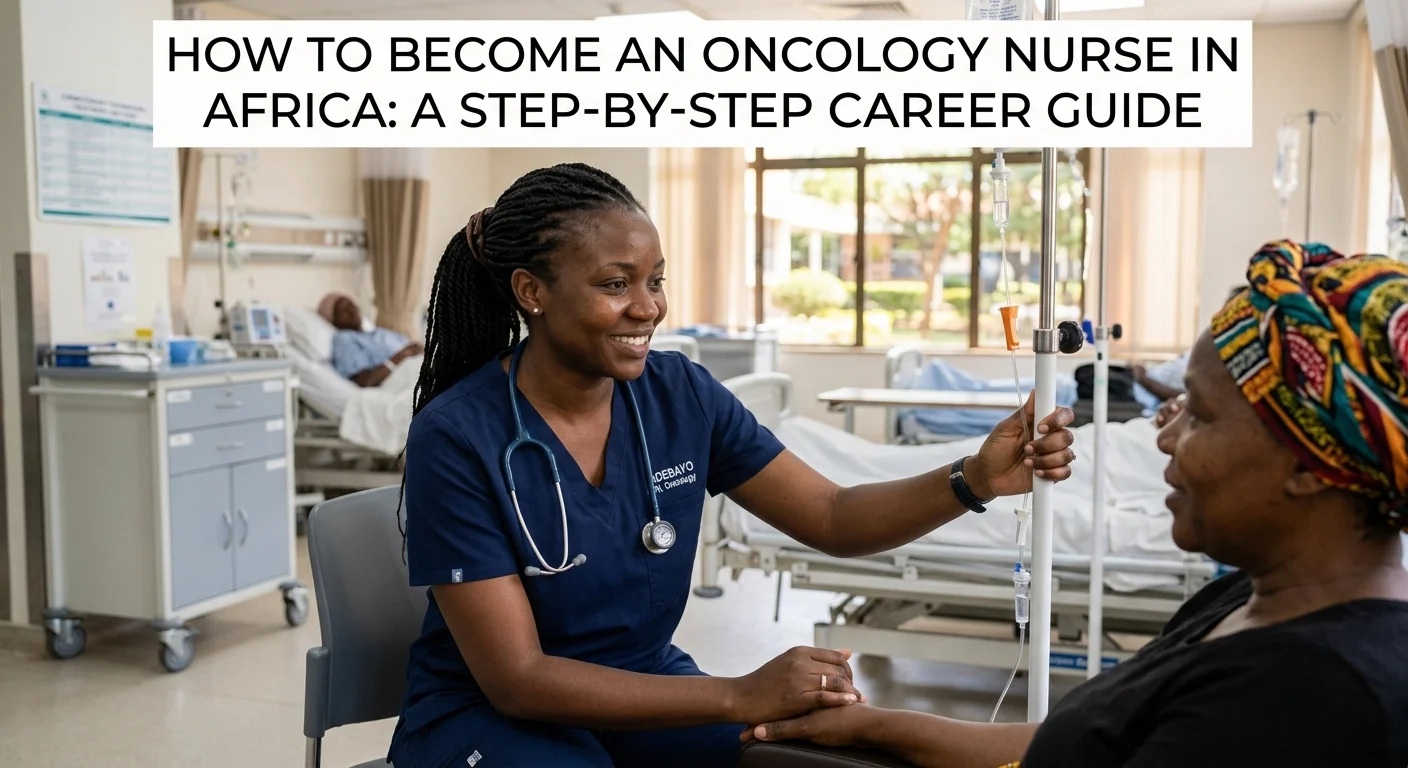
Oncology nurses provide care to cancer patients while they are undergoing treatment. This specialty may be demanding and requires a great deal of compassion and perseverance.
Table of Contents
- Accredited Schools Offering Oncology Nursing Programmes in Africa
- What Role Do Oncology Nurses Play?
- How to Become an Oncology Nurse?
- How to Become an Oncology Nurse in Africa: Step by Step
- Step 1: Complete Your Foundational Nursing Education
- Step 2: Obtain Your General Nursing License
- Step 3: Decide Whether Oncology Nursing Is the Right Fit
- Step 4: Gain Relevant Clinical Experience
- Step 5: Complete Post-Basic Oncology Nursing Training
- Step 6: Pursue Oncology Certification
- Step 7: Consider Advanced Practice (Optional)
- Skills Every Oncology Nurse Needs
- How much do oncology nurses earn?
- Frequently Asked Questions
- Conclusion
Accredited Schools Offering Oncology Nursing Programmes in Africa
Formal oncology nursing education is still developing across the continent, but several countries now run accredited, regulator-recognized programmes. Here’s where you can currently train:
Nigeria
- School of Post-Basic Nursing, National Hospital Abuja — offers a post-basic Diploma in Oncology Nursing, currently the only dedicated oncology nursing training programme in the country. It’s hospital-based and open to registered nurses with prior clinical experience.
South Africa
- University of the Witwatersrand — offers oncology specialization within its postgraduate nursing programmes, including an MSc in Nursing with an Oncology and Palliative Care track.
- Gauteng College of Nursing — runs a postgraduate diploma in Oncology and Palliative Nursing aimed at producing oncology and palliative nurse specialists.
- Cape Peninsula University of Technology (CPUT) — offers a BTech in Oncology through its Faculty of Health and Wellness Sciences.
- Lilitha College of Nursing (Addington Campus, Durban) — offers oncology specialization within its diploma nursing programmes.
Kenya
- Kenya Medical Training College (KMTC), Mosoriot Campus — offers a Higher Diploma in Oncology Nursing, a two-year programme open to registered nurses with a valid Nursing Council of Kenya (NCK) practising license and at least one year of post-registration experience.
- Kenyatta University Teaching, Referral and Research Hospital (KUTRRH) — its Training Institute for Specialized Nursing offers higher diploma courses in specialized nursing, approved by the NCK.
Ghana
- Ghana College of Nurses and Midwives — runs a postgraduate Oncology Nurse Specialist programme, credentialed by the Nursing and Midwifery Council of Ghana. Entry requires a bachelor’s degree in nursing and at least three years of clinical experience; the programme includes a three-year residency followed by two years of sub-specialty training and research.
Zambia
- University of Zambia (UNZA), School of Nursing Sciences — offers a Bachelor of Science in Oncology Nursing, open to both pre-service candidates and in-service diploma-holding nurses registered with the General Nursing Council of Zambia.
Availability and admission requirements can shift as programmes expand, so always confirm current accreditation status directly with the relevant national nursing council, the Nursing and Midwifery Council of Nigeria (NMCN), the Nursing Council of Kenya (NCK), the South African Nursing Council (SANC), or the equivalent body in your country, before applying.
READ ALSO: Highest Nursing Jobs That Pay Well
What Role Do Oncology Nurses Play?
The primary responsibility of an oncology nurse is to supervise and provide nursing care to cancer patients. They keep track of the patient’s status, create care plans, create symptom management regimens, and provide medicine.
They frequently see patients suffering; yet, this enormous burden is mitigated by the relationships they develop with patients and their families. Oncology nurses typically function as the main person and communication between patients and other medical professionals.
An oncology nurse performs a variety of duties. They work as caretakers, facilitators, assistants, and healthcare managers, among other things. Their main responsibilities include:
- Tracking patient reactions to therapy and medication
- Providing information to patients and their loved ones about treatment processes and expectations.
- Assisting patients in connecting with clinical and community resources as a nurse navigator
- Researching to improve care quality
- Keeping up with the most recent research and developments in cancer care
- Ensure Chemotherapy, radiation, and immunotherapy therapies are being administered.
- Instruct patients and their families about treatment expectations.
- Constantly monitor and document the patient’s improvement.
- Keep track of the patient’s reaction to therapy and drugs.
How to Become an Oncology Nurse?
An oncology nurse should be a registered nurse with valid state licensure. While a four-year bachelor’s degree in nursing is preferable, prospective nurses may choose to begin their careers with a three-year diploma program.
- Determine whether oncology nursing is a good fit for you- Working with patients who have chronic or terminal diseases necessitates a high degree of emotional intelligence and mental resilience.
- Gain proper experience – To become an oncology nurse, you must first gain a set of cancer care skills through continuing education, clinical practice, or study. After gaining appropriate knowledge and experience, you may sit for an exam to become a qualified oncology nurse.
- Get an oncology certification – Advanced certifications can help you advance in your profession and stand out as a job seeker.
- To be an oncology nurse practitioner, one requires to acquire a master’s degree in nursing, which normally takes 2 extra years to finish. After finishing the graduate program, you can apply for recognition on your state’s nursing board and become an advanced practice nurse (APN).
How to Become an Oncology Nurse in Africa: Step by Step
Step 1: Complete Your Foundational Nursing Education
Every path to becoming an oncology nurse in Africa starts with a recognized general nursing qualification. Depending on the country, this could be a three-year diploma program (such as an ND/HND nursing qualification) or a four-year Bachelor of Nursing Science (BNSc) degree. A bachelor’s degree is generally preferred by employers and opens more doors for career advancement, but a diploma-level qualification remains a valid and common starting point across much of the continent.
Step 2: Obtain Your General Nursing License
After completing your foundational training, you’ll need to sit your country’s national licensing examination — for example, the Nursing and Midwifery Council of Nigeria (NMCN) exam — to become a fully Registered Nurse (RN). This license is non-negotiable; it’s the credential every subsequent oncology specialization builds on.
Step 3: Decide Whether Oncology Nursing Is the Right Fit
Working closely with patients facing chronic or terminal illness requires real emotional intelligence and mental resilience. Before committing to specialization, it’s worth spending time in oncology or palliative care settings — through clinical placements or shadowing — to understand what the work genuinely demands day to day.
Step 4: Gain Relevant Clinical Experience
Most post-basic oncology nursing programs require candidates to hold an active nursing license plus a minimum period of clinical experience — often around six months to a year — before admission. Use this time to build core clinical skills in general medical-surgical nursing, which forms the foundation for cancer-specific care.
Step 5: Complete Post-Basic Oncology Nursing Training
This is where you formally specialize. In Nigeria, for example, the School of Nursing at National Hospital Abuja runs a post-basic oncology nursing programme lasting 12 to 18 months, open to registered nurses with prior clinical experience. Similar post-basic oncology tracks exist at teaching hospitals and specialized cancer centers in other African countries, including South Africa, Kenya, and Ghana. These programs combine classroom instruction in cancer biology, chemotherapy administration, and symptom management with supervised clinical practice.
Step 6: Pursue Oncology Certification
Once you’ve completed post-basic training, pursuing formal oncology certification, where available through bodies like national nursing councils or oncology nursing societies, can strengthen your credentials and set you apart in a competitive job market. Certification signals to employers that your knowledge meets a recognized clinical standard.
Step 7: Consider Advanced Practice (Optional)
For nurses aiming even higher, becoming an oncology nurse practitioner requires a master’s degree in nursing, typically adding two more years of study after your bachelor’s. Graduates can then apply for advanced practice recognition with their country’s nursing regulatory body, qualifying them to take on expanded clinical responsibilities, including aspects of diagnosis and treatment planning.
READ ALSO: Highest Paying Specialties in Africa
Skills Every Oncology Nurse Needs
Beyond formal qualifications, thriving as an oncology nurse in Africa requires:
- Emotional resilience: the ability to support patients through fear, pain, and loss without burning out
- Sharp clinical judgment: recognizing subtle changes in a patient’s condition quickly
- Strong communication: explaining complex treatment information in accessible language
- Attention to detail: chemotherapy dosing and administration leave little room for error
- Cultural sensitivity: understanding how cancer diagnosis and treatment intersect with local beliefs, stigma, and family dynamics across diverse African communities
How much do oncology nurses earn?
In terms of pay, the average income of a pediatric oncology nurse is $79,000, which is much more than the average salary of a registered nurse. An advanced certified oncology nurse, on the other hand, earns an average income of $93,000. Nursing occupations have a positive career outlook.
South Africa Oncology nurses are among the better-compensated nursing specialists on the continent. Average annual pay sits around R370,000–R463,000, with entry-level oncology nurses (1–3 years’ experience) earning closer to R265,000, and senior specialists with 8+ years’ experience earning R463,000 or more. Some sources report averages as high as R684,000 for more senior oncology nursing roles, reflecting how much pay varies by facility and seniority.
Nigeria General registered nurses in Nigeria typically earn between ₦150,000 and ₦400,000 monthly depending on experience, with federal government nurses paid under the Consolidated Health Salary Structure (CONHESS). Specialist nurses, including oncology-trained nurses, generally command the upper end of the scale, often earning ₦350,000 to ₦500,000 monthly or more, particularly in private hospitals, teaching hospitals, and NGO-run cancer centers.
Kenya Oncology nurse salaries in Kenya vary widely depending on the employer and region, with private hospitals and specialized cancer centers in Nairobi generally paying more than public facilities. As with much of the region, salaries for this specialty are still catching up to demand, and pay data remains limited due to the small number of formally trained oncology nurses in the country.
Ghana Oncology Nurse Specialists trained through the Ghana College of Nurses and Midwives are salaried under Ghana’s Ministry of Health structure. Because the specialist pathway includes a multi-year postgraduate residency and sub-specialty training, graduates typically earn more than general nurses, progressing through a formal career ladder — from Oncology Nurse Specialist to Senior Specialist to Consultant Oncology Nurse Specialist, with pay increasing at each stage.
Professionals in advanced nursing such as oncology nurses would be sought, notably in central urban and rural areas where healthcare and medical attention is sought after.
Suitable Resources
- Oncology Nursing Society
- Oncology Nursing Certification Corporate
- Association of Pediatric Oncology Nurses
Frequently Asked Questions
1. Can I become an oncology nurse in Africa with just a diploma? Yes. A three-year diploma-level nursing qualification (such as ND/HND) is a valid entry point. After becoming a licensed RN and gaining clinical experience, you can pursue post-basic oncology specialization just as a degree holder would.
2. How long is post-basic oncology nurse training? Most post-basic oncology nursing programs run 12 to 18 months and require an active nursing license plus prior clinical experience for admission.
3. What’s the difference between an oncology nurse and an oncology nurse practitioner? An oncology nurse provides direct clinical and supportive care to cancer patients. An oncology nurse practitioner holds a master’s degree and has expanded clinical authority, including aspects of diagnosis and treatment planning, as an advanced practice nurse.
4. Is oncology nursing emotionally difficult? It can be. Working closely with patients facing serious or terminal illness requires strong emotional resilience, but many oncology nurses describe the relationships they build with patients and families as one of the most rewarding parts of the job.
5. Where can I train as an oncology nurse in Nigeria? The School of Nursing at National Hospital Abuja offers a recognized post-basic oncology nursing programme for registered nurses with prior clinical experience.
Read Also: How to get Nursing Oncology Certification
Conclusion
In conclusion, if one wants to make a career out of being an Oncology Nurse, then one needs to complete relevant educational requirements, followed by gaining experience in a work setting where able to apply skills learned during studies, whilst taking steps to obtain licensure certification from the respective governing bodies and institutions. With dedication, hard work, and ambition could find yourself making a difference in the lives of people suffering from life-threatening illnesses in the very near future!
Becoming an oncology nurse in Africa takes years of dedicated study, hands-on clinical experience, and genuine emotional commitment, but for those who choose this path, it offers the chance to make a profound difference in the lives of patients facing one of life’s hardest battles.


