
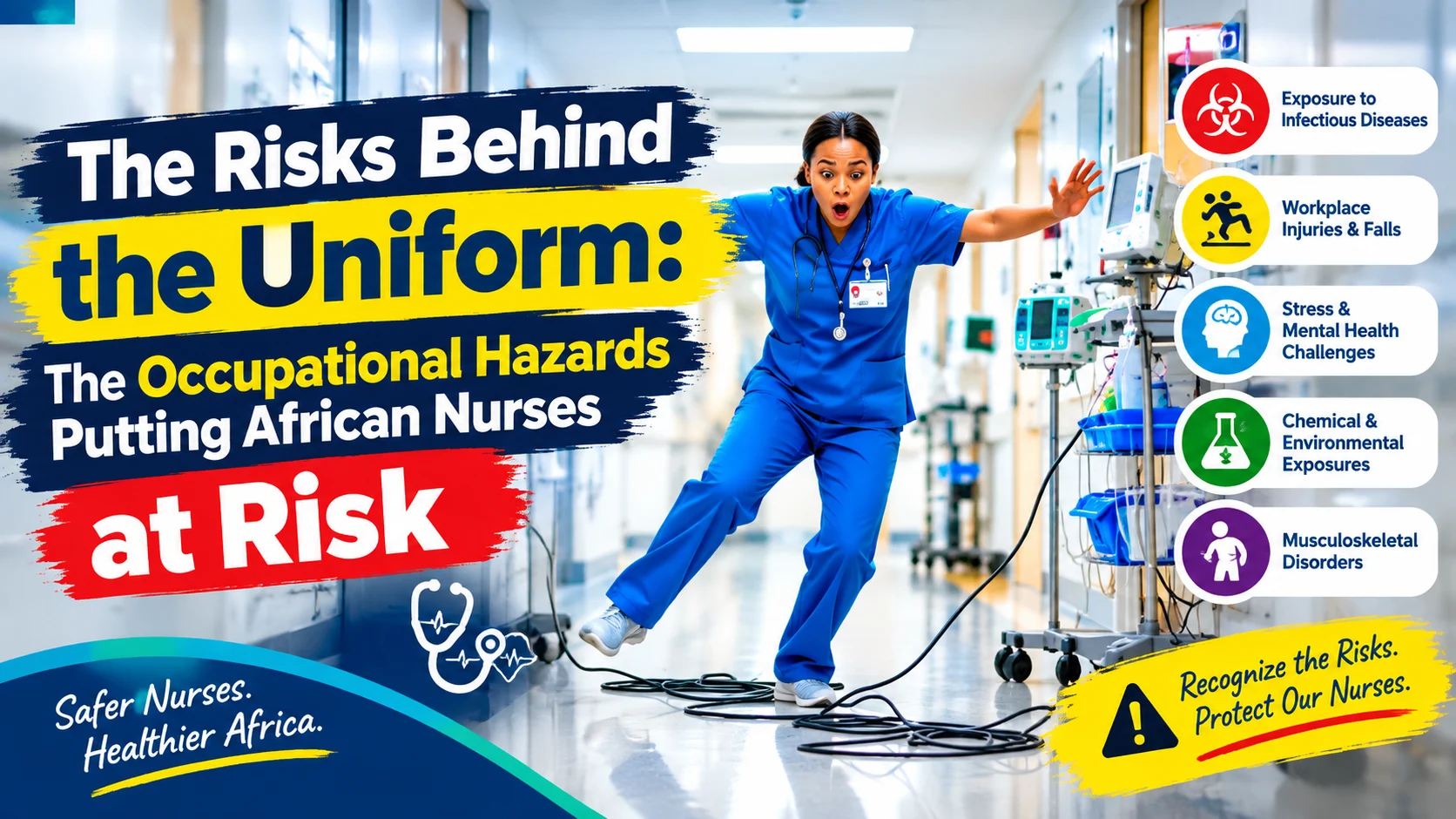
The Risks Behind the Uniform: The Occupational Hazards Putting African Nurses at Risk

Abdullahi Suleiman
September 7, 2026
Nurses spend their working days caring for people at some of their most vulnerable moments. But behind the care they provide is a workplace that can expose them to infection, injury, chronic pain, psychological distress and financial hardship.
Occupational hazards are not simply “accidents that happen at work.” They are conditions, exposures or practices within the work environment that increase a worker’s likelihood of experiencing illness, injury, disability or even death. In healthcare, these hazards can be physical, biological, chemical, ergonomic or psychosocial.
For nurses across Africa, these risks can be intensified by understaffing, inadequate infrastructure, limited access to personal protective equipment, heavy workloads and weak occupational health and safety systems.
Table of Contents
- Physical hazards: When the workplace can cause injury
- Biological hazards: The danger nurses cannot always see
- Ergonomic hazards: The physical cost of caring
- Chemical and radiation hazards
- Workplace violence: When caring becomes dangerous
- The mental health cost
- The economic cost nobody sees
- Protecting the people who provide care
- Conclusion: A safer system starts with safer nurses
- References
Physical hazards: When the workplace can cause injury
Nurses routinely work around needles, scalpels, medical equipment, slippery floors, electrical equipment, radiation and other physical dangers.
A 2026 study of healthcare workers in public hospitals in KwaZulu-Natal, South Africa, found that 98.6% of participants reported exposure to physical hazards. These included radiation, heat, cold, slips and trips, electrical hazards and injuries associated with dangerous equipment.
For nurses, physical hazards are not limited to dramatic accidents. Poor lighting, overcrowded wards, faulty equipment, wet floors and inadequate workspaces can create repeated risks throughout a shift.
The consequences can range from cuts and falls to serious injuries that require treatment and time away from work.
But there is another category of occupational hazard that is easier to overlook: the conditions that make other hazards more likely.
When one nurse is expected to care for too many patients, work excessive hours or function without adequate equipment, the risk of injury, fatigue and error increases. In this sense, unsafe working conditions themselves can become a hazard.
Biological hazards: The danger nurses cannot always see
Perhaps one of the most serious occupational risks for African nurses is exposure to infectious diseases.
Nurses come into contact with blood, body fluids, respiratory secretions, wounds and infectious patients throughout their work. Needlestick injuries and other sharps injuries can expose them to blood-borne infections such as hepatitis B, hepatitis C and HIV. Nurses may also encounter airborne infections such as tuberculosis and respiratory viruses.
The burden is significant. A systematic review of occupational hazards among healthcare workers in Africa found lifetime needlestick injury rates ranging from 22% to 95% across the studies reviewed.
Nigerian research also illustrates the problem. In one teaching hospital, 70% of participating nurses reported experiencing a needlestick injury within the preceding year. Many injuries were not formally reported, while only a minority of those injured received post-exposure prophylaxis.
This creates a problem that extends beyond the physical injury.
A nurse who has experienced a potentially infectious exposure may spend weeks worrying about test results, treatment and what the exposure could mean for their health and family.
Occupational safety, therefore, is not only about preventing infection. It is also about preventing the fear and uncertainty that can follow exposure.
Ergonomic hazards: The physical cost of caring
Nursing is physically demanding.
Lifting and repositioning patients, transferring patients between beds and wheelchairs, prolonged standing, bending over beds and working in awkward positions can place considerable strain on the body.
The recent South African study found ergonomic exposure among 94.4% of healthcare workers surveyed. Patient handling, prolonged standing, awkward postures and repetitive tasks were among the concerns identified.
For nurses, these hazards can contribute to back pain, neck pain, fatigue and other musculoskeletal problems.
And these injuries are not always dramatic enough to make headlines.
Sometimes the occupational injury is the back that hurts after every shift. The knees that ache after years of standing. The shoulder that never quite recovered after repeatedly moving patients.
Over time, these seemingly minor problems can become chronic conditions that affect a nurse’s ability to work and quality of life.
Chemical and radiation hazards
Nurses may also be exposed to hazardous chemicals through disinfectants, sterilising agents, medications, anaesthetic gases and other substances used within healthcare facilities.
Depending on the substance and level of exposure, these chemicals can contribute to skin irritation, respiratory problems, allergic reactions and other health effects.
Radiation presents another occupational concern for nurses who work around X-rays and other radiation-emitting equipment.
These hazards may be less visible than a needlestick or workplace assault, but that does not make them less important. Effective protection requires appropriate equipment, training, monitoring and clear safety procedures.
READ ASLO: Sickle cell disease in Africa: Symptoms, Complications and how nurses are fighting back
Workplace violence: When caring becomes dangerous
Imagine coming to work to care for a patient and leaving with a bruise, a threat, an insult or the memory of being sexually harassed.
For many nurses, workplace violence is not an abstract possibility.
A systematic review and meta-analysis involving 9,831 nurses across Africa found that 62.3% had experienced workplace violence. Verbal abuse was the most common form, followed by threats, bullying, physical abuse and sexual harassment.
Violence can come from patients and relatives, but it can also occur between colleagues and within organisations.
The problem is particularly concerning because violence can become normalised.
A nurse may be told to “ignore it.” They may fear reporting because nothing will happen. Or they may simply accept abuse as part of the job.
It should not be.
No level of commitment to patient care makes violence an acceptable occupational condition.
The mental health cost
Occupational hazards do not only leave physical scars.
Working long shifts while understaffed, caring for critically ill patients, witnessing suffering and death, fearing infection, dealing with violence and constantly worrying about making mistakes can create a psychologically unsafe environment.
Long working hours, shift work, excessive workload, lack of support and limited control over work are recognised contributors to occupational stress, burnout and fatigue.
And mental and physical safety cannot really be separated.
A severely fatigued nurse may struggle to concentrate. A nurse experiencing chronic stress may find it harder to recover between shifts. Someone who has experienced workplace violence may become anxious about returning to work.
The consequences can include burnout, absenteeism, reduced productivity, poor job satisfaction and ultimately the decision to leave the workplace or profession.
The economic cost nobody sees
There is another cost of occupational hazards that is often missing from the conversation: money.
When nurses become injured or ill, there are immediate costs. They may need medication, medical care, laboratory tests or time away from work. If an injury becomes chronic, the financial consequences can become much greater.
But the economic burden does not stop with the individual nurse.
Healthcare facilities also absorb the consequences through absenteeism, reduced productivity, overtime for other staff, recruitment and training of replacements, and increased pressure on already understaffed teams.
This creates a cycle.
Understaffing increases workload. Increased workload contributes to fatigue and occupational risk. Injury, illness or burnout can remove nurses from the workforce. The remaining nurses then carry an even heavier workload.
In countries already struggling with healthcare workforce shortages, allowing nurses to become sick or leave because of unsafe working conditions is an expensive problem.
Nurse safety is therefore not merely an employee welfare issue. It is a workforce investment.
READ ALSO: Compassion Fatigue: Protecting Nurses Mental Health in resources scarce setting
Protecting the people who provide care
Occupational hazards cannot be solved by simply telling individual nurses to “be more careful.”
Nurses have a responsibility to follow safety procedures, but responsibility must be matched with a safe environment in which those procedures are actually possible.
Healthcare facilities need adequate staffing, reliable PPE, safe sharps disposal, vaccination and post-exposure protocols, infection prevention systems, ergonomic equipment, violence-prevention policies, radiation protection, regular safety training and accessible occupational health services.
Nurses must also be able to report injuries and unsafe conditions without fear of blame or retaliation.
Most importantly, occupational safety needs to become part of how healthcare is designed, managed and funded—not something addressed only after an injury occurs.
Conclusion: A safer system starts with safer nurses
African nurses cannot continue to be treated as if their ability to endure difficult working conditions is proof of their dedication.
Caring for others should not require nurses to sacrifice their physical health, mental well-being or financial security.
The nurse who gets injured by a needle, develops chronic back pain, experiences violence, becomes infected at work or burns out from unsustainable working conditions is not simply an individual casualty.
That nurse is part of a larger system that has failed to adequately protect the people keeping it running.
If we want safer hospitals, better patient outcomes and stronger health systems, we must also ask a simple question:
Are the people providing care safe enough to keep caring?
Protecting nurses is not separate from protecting patients.
It is part of it.
References
Ekpor, E., et al. (2024). Prevalence and predictors of workplace violence against nurses in Africa: A systematic review and meta-analysis. Health Science Reports, 7(5), e2068. (PubMed Central (PMC))
Mossburg, S., Agore, A., Nkimbeng, M., & Commodore-Mensah, Y. (2019). Occupational hazards among healthcare workers in Africa: A systematic review. Annals of Global Health, 85(1). (PubMed)
Ngobe, S. A., Ana, G. R. E. E., Campbell, P. S., & Melariri, P. E. (2026). Prevalence and comparative analysis of occupational hazards among healthcare workers in public hospitals located in rural and urban areas of KwaZulu-Natal, South Africa. Advances in Public Health. (Wiley Online Library)
World Health Organization. (2022). Caring for those who care: Guide for the development and implementation of occupational health and safety programmes for health workers. World Health Organization. (who.int)
World Health Organization. (2024). Occupational hazards in the health sector. (who.int)
World Health Organization Regional Office for Africa. (2023). Infection prevention and control guideline: Health worker safety. (WHO | Regional Office for Africa)
Prevention of Nurses’ Workplace Safety and Hazards in Mogadishu Hospitals, Somalia. (2025). ResearchGate. (Wiley Online Library)


