
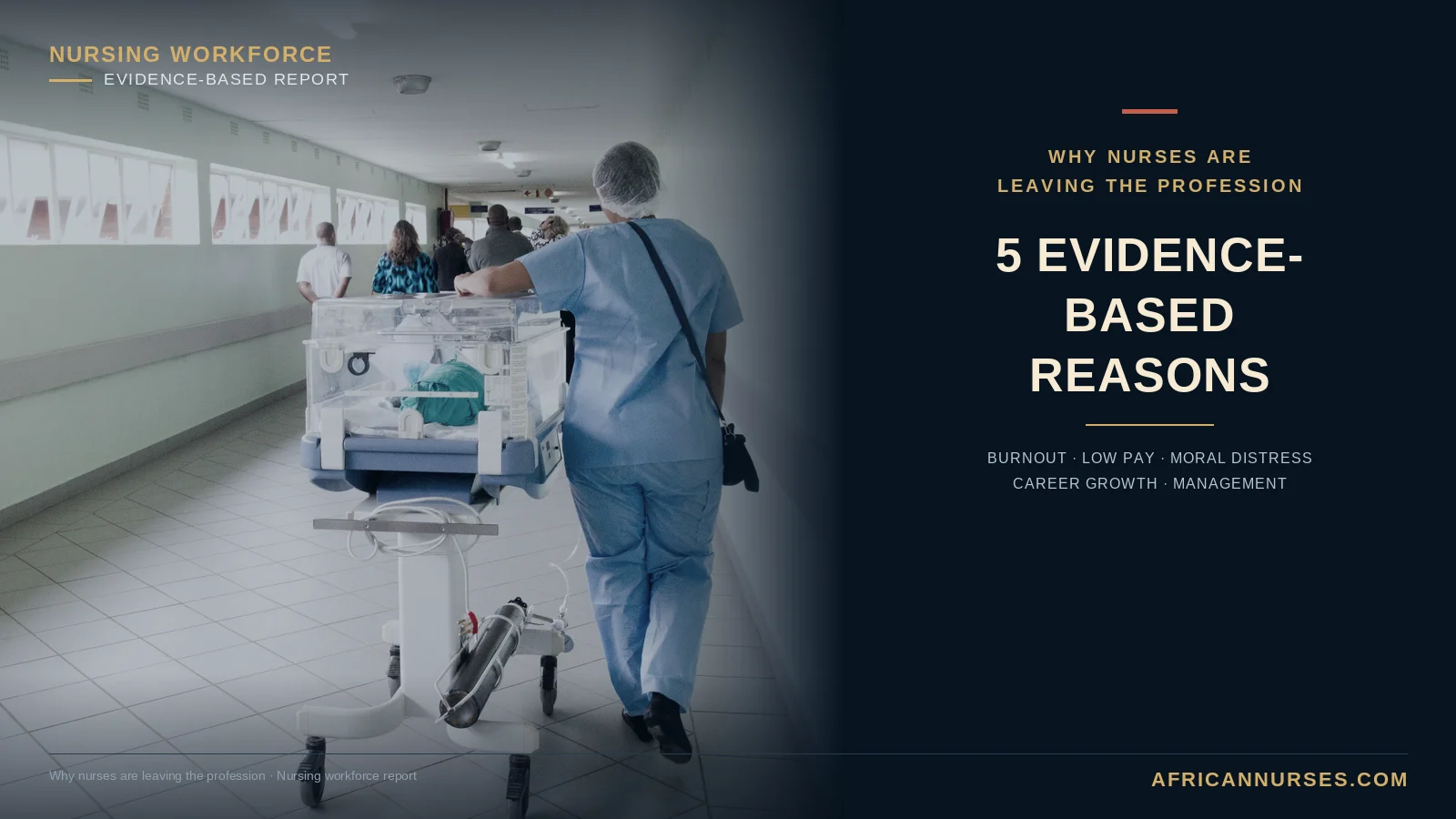
Why Nurses Are Leaving the Profession: 5 Evidence-Based Reasons

Africannurses
August 30, 2026
Most practicing nurses have heard some version of the same conversation in the break room, where a colleague quietly admits they have applied for a job outside healthcare. Or a younger nurse says they are not sure they will still be a nurse in five years.
These conversations are not necessarily about relocating to another country. They are about leaving nursing as a profession, and research shows that this is a real workforce concern.
Why nurses are leaving the profession is a different question from why nurses migrate abroad, and it matters to keep the two separate. A nurse who moves to another country is still practicing. But a nurse who leaves the bedside for an unrelated career, or leaves healthcare altogether, represents a different kind of loss to the health system.
Table of Contents
Five Reasons Why Nurses Are Leaving the Profession
Researchers studying nurses’ decisions to leave have identified two related but different outcomes. These outcomes are the intention to leave a specific nursing job and the intention to leave the nursing profession entirely.
The distinction matters because a nurse who changes hospitals or moves into another nursing role remains part of the nursing workforce, while a nurse who leaves nursing altogether takes their clinical knowledge and experience out of the profession.
Research also shows that the factors associated with these two decisions can differ. A 2025 study of nurses in Kenya, for example, found that 81.4% intended to leave their current jobs, while 31.4% intended to leave the nursing profession.
Below are five major reasons identified across research on nurses who leave or intend to leave the profession.
1. Burnout, Emotional Exhaustion and Workplace Violence
Burnout and emotional exhaustion can make staying in nursing increasingly difficult, particularly when nurses feel they have little support to manage the demands of the job.
A 2022 study of 375 nursing professionals in Kumasi, Ghana, found that 49.3% had considered quitting the profession. Emotional exhaustion was strongly associated with this intention, as nurses experiencing emotional exhaustion had higher odds of intending to leave the profession.
Another 2025 study of early-career registered nurses in South African hospitals found that 20% to 40% of nurses leave their jobs within their first two years of practice. In the same study, 14.5% of participants reported considering leaving the nursing profession.
These studies identified emotional exhaustion, workplace violence, personal accomplishments, and dissatisfaction with aspects of the nursing career as reasons why nurses leave the profession.
2. Pay That Does Not Match the Risk
Compensation is not the only reason nurses stay or leave, but financial dissatisfaction can become difficult to ignore when combined with demanding working conditions.
A 2020 study of 413 nurses working at public hospitals in Central Ethiopia found that 61.3% intended to leave the nursing profession. According to the study, most of the nurses (78.4%) intend to leave the profession because of low salaries.
It is not particularly difficult to understand why. Nursing is a profession that requires long shifts, emotional labour, clinical responsibility, and exposure to workplace risks. When nurses believe their compensation does not reflect those demands, it can become a reason to reconsider the profession itself.
It is important to note that pay alone does not explain why nurses leave. A salary increase may not solve the problem of nurses remaining overworked, unsupported, or unable to develop professionally.
3. Moral Distress and Disillusionment With Nursing
Sometimes the problem is not simply that nursing is difficult. It is that the reality of nursing no longer resembles what the nurse believed they were entering.
A 2023 qualitative meta-aggregation published in the Journal of Advanced Nursing identified four broad reasons behind nurses’ decisions to leave the profession. They include:
- Challenging work environments
- Emotional distress
- Disappointment with the reality of nursing, and
- A culture of hierarchy and discrimination.
The review found that nurses described a gap between what they were trained to do and what they were actually able to do in practice. Some experienced moral distress when they could see what patients needed but felt unable to provide the standard of care they believed was appropriate.
Others described disappointment with the reality of nursing, including work that felt repetitive, limited autonomy, and insufficient support to influence change.
Over time, that gap can become more than ordinary job dissatisfaction. It can change how a nurse sees the profession itself.
4. Limited Career Growth and Feeling Stuck
Nursing is not supposed to end at the bedside. Nurses can move into specialist practice, education, leadership, research, public health, administration, and other areas. But those pathways are not equally accessible in every health system.
The qualitative review mentioned above found that a lack of opportunities for career development and professional growth was among the factors associated with nurses leaving the profession. Nurses described frustration when they could not see meaningful opportunities to advance, develop autonomy or use their skills in new ways.
The issue is particularly important for nurses who entered the profession with ambitions beyond routine clinical work.
Related: Career Progression in Nursing: The Complete Path from Nursing School to Professorship
5. Poor Management and Lack of Support
A nurse can be committed to patients and still become discouraged by the organisation around them.
A 2024 systematic review of qualitative studies examining nurses who resigned from healthcare organisations or abandoned the profession found poor management practices to be the most consistently reported factor.
The review identified:
- Ineffective leadership
- Lack of support and unfair treatment alongside excessive workloads
- Bullying
- Poor work-life balance, as factors impacting nurses’ stay in the profession.
This matters especially because nurses do not experience their jobs only through their clinical duties. They also experience them through the people who schedule their shifts, respond to concerns, allocate workloads, handle conflict, and decide whether professional development is supported.
When management repeatedly fails to provide that support, nurses may begin to see leaving as their only realistic option.
Who Is Most at Risk of Leaving the Profession?
Research does not point to one single type of nurse who leaves. However, two groups deserve particular attention. These groups are early-career nurses and nurses working in demanding, high-acuity environments.
Early-career nurses can be especially vulnerable because the transition from nursing school into professional practice brings new clinical responsibilities, workplace relationships, and expectations.
The second group, nurses in high-acuity units, may also face particularly intense pressures. This could be due to overwhelming workload and disrupted work-life balance.
This does not mean that every early-career nurse or specialist nurse is destined to leave. It means these groups can provide important warning signs for employers and policymakers.
Leaving Nursing Is Not the Same as Migrating
International migration is an important part of Africa’s nursing workforce crisis, but it should not be confused with professional attrition.
A nurse who moves from Nigeria to the United Kingdom, for example, may leave the Nigerian health system, but they have not left nursing. Their skills remain within the global nursing workforce.
But a nurse who moves into an unrelated profession, leaves healthcare entirely, or decides never to practise nursing again represents a different type of workforce loss.
The distinction matters because they each require different solutions.
Related: Nursing Scholarships in Africa
What Could Be Done to Keep Nurses in the Profession?
Understanding why nurses are leaving the profession only matters if it leads to action. A few evidence-backed strategies stand out:
1. Support Nurses During the Transition Into Practice
Early-career nurses should not be expected to navigate the transition from student to independent practitioner without structured support.
Strategies like mentorship, transition-to-practice programmes and supportive supervision can help nurses develop confidence while giving them somewhere to turn when the realities of practice become overwhelming.
- Address Workplace Violence and Bullying
Bullying and workplace violence should not be treated as an unavoidable part of nursing culture. Healthcare organisations need clear reporting systems, accountability and leadership that does not tolerate abusive behaviour.
3. Create Real Career Pathways
Retention becomes more difficult when nurses cannot see where their careers can go. Hospitals and nursing organisations can strengthen retention by creating accessible pathways into specialist practice, education, leadership, research and other areas of professional development.
4. Improve Working Conditions and Management
Nurses leave the profession because of structural issues, including workload, staffing, leadership, work-life balance, salary, and professional support.
This means retention strategies should change the conditions in which nurses work rather than simply teaching nurses how to cope with those conditions.
A wellness webinar may help temporarily, but it cannot substitute for adequate staffing, fair management, safe workplaces, and meaningful professional development.
- Fair and Competitive Pay
Better pay can improve job satisfaction, reduce the pressure to take multiple jobs or leave the profession altogether, and make nursing a more sustainable career.
FAQs About Why Nurses Are Leaving the Profession
1. Why are nurses leaving the profession in such high numbers? A combination of burnout, low pay relative to risk, moral distress, limited career growth, and poor management is consistently identified across research as the reason nurses leave the profession rather than simply changing jobs.
2. Is nurse migration the same as nurses leaving the profession? No. A nurse who migrates abroad is still practicing nursing and remains part of the global nursing workforce. A nurse who leaves nursing for an unrelated career represents a separate, more permanent form of workforce loss.
3. Which nurses are most at risk of leaving? Early-career nurses and those working in high-acuity, demanding units face the highest documented risk, largely due to the pressures of transition and workload.
4. Can better pay alone stop nurses from leaving? Not on its own. While low pay is a major factor, research shows that workload, management, and career growth also need to improve for retention efforts to work.
Conclusion
Why nurses are leaving the profession comes down to a combination of conditions such as burnout, poor pay, work dissatisfaction, limited opportunities for career growth, and management structures that leave nurses feeling unsupported rather than led.
None of this is the same story as a nurse choosing to work abroad. It is a story about people leaving nursing itself, sometimes while remaining in the same city where they trained.
If African health systems want to retain their nurses, the answer cannot simply be to ask them to cope better. The profession itself must become a place where nurses can work safely, develop professionally, feel supported, and see a future worth staying for.