
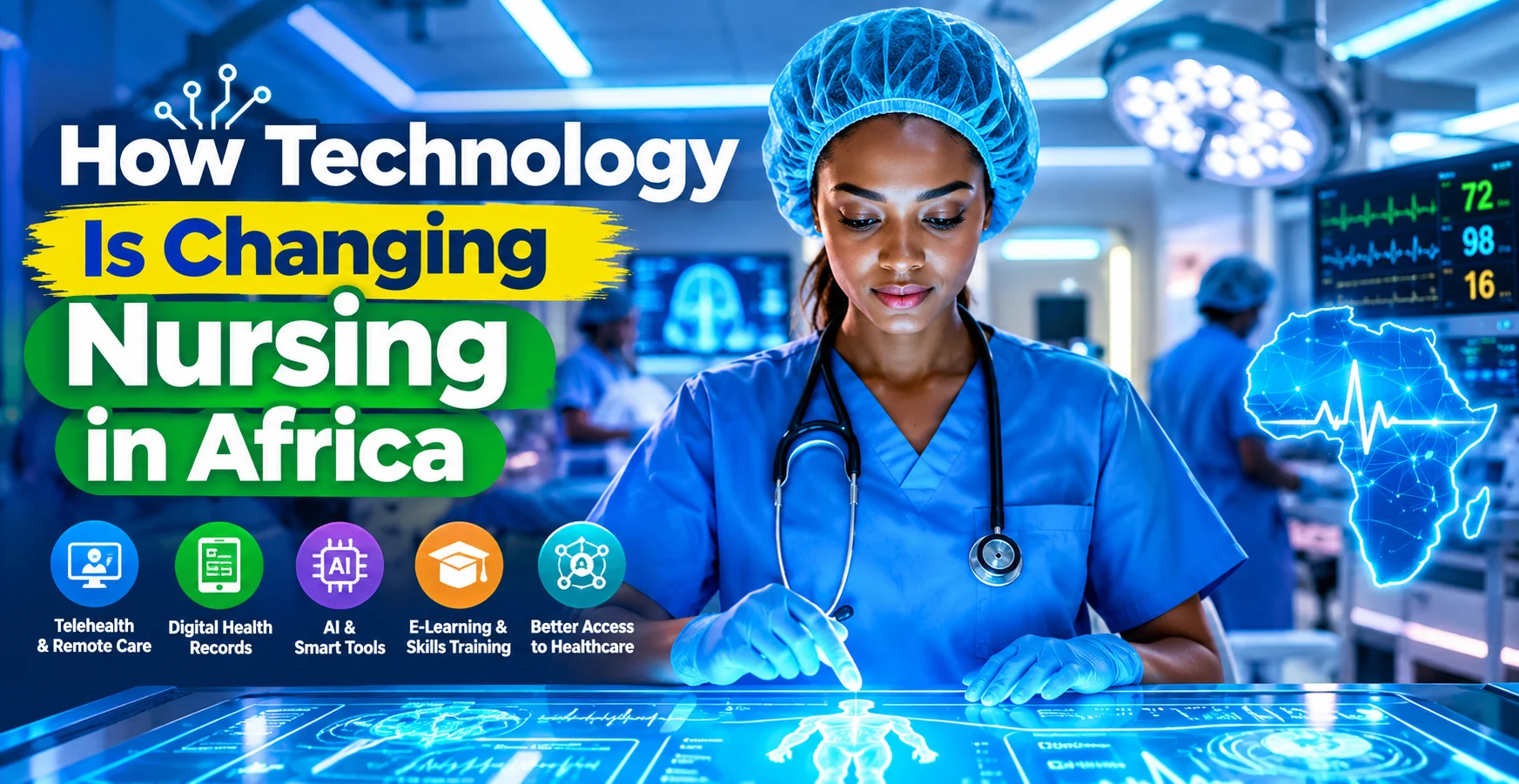
How Technology Is Changing Nursing in Africa (2026 Guide)

Abdullahi Suleiman
September 6, 2026
For generations, nursing has been solely associated with the bedside: taking vital signs, administering medications, dressing wounds, educating patients, documenting care and providing the human connection that healthcare cannot do without. Understanding how technology is changing nursing in Africa starts with recognizing that this shift is already underway: technology is steadily expanding what the profession looks like, changing how nurses document care, communicate with patients, access information, make decisions, and even deliver care from a distance.
Across Africa, technology is gradually changing how nurses document care, communicate with patients, access information, make decisions and even deliver care from a distance.
From electronic health records and telemedicine to mobile health applications, digital monitoring tools and artificial intelligence, technology is becoming part of the healthcare environment in which nurses work.
The question is no longer whether technology will change nursing. It already is.
The more important question is whether African nurses are prepared to participate in that change.
READ ALSO: Will AI replace Nurses & Is Nursing Worth studying in Africa
Table of Contents
- From Paper Folders to Digital Records
- Telemedicine Is Expanding the Reach of Nursing
- Technology Is Changing How Nurses Make Decisions
- Artificial Intelligence Is Entering the Conversation
- The Nurse’s Role Is Expanding
- Technology Should Not Make Healthcare Less Human
- Nurses Must Be Part of the Digital Transformation
- The Digital Nurse Is Still a Nurse
- What This Means for African Nurses
- Conclusion: Technology Is Changing Nursing. We Must Help Shape How.
How Technology Changing Nursing in Africa?
- Electronic health records (EHRs) are gradually replacing paper documentation, though adoption remains uneven due to training gaps and infrastructure limits.
- Telemedicine and mobile health platforms are extending nursing care to rural and underserved communities.
- Clinical decision-support tools are giving nurses faster access to patient data and guidelines at the point of care.
- Artificial intelligence is entering nursing through documentation support, risk identification, and data analysis but raises real questions about accountability and fairness.
- Digital literacy is becoming a core professional competency alongside clinical skill.
- African nurses need locally designed digital health in Africa solutions, not copy-pasted tools built for different environments.
From Paper Folders to Digital Records
One of the most visible changes is the movement from paper-based documentation to electronic health records (EHRs).
For nurses, documentation is not a minor administrative task. It is part of patient safety, communication, continuity of care and professional accountability.
Electronic systems can make patient information easier to access, improve documentation, reduce duplication and support continuity between healthcare professionals.
Yet adoption across Africa remains uneven.
A 2025 scoping review of research on EHR adoption among nurses in Africa found that many settings still rely heavily on paper records. Studies from Nigeria, South Africa and Kenya identified challenges including inadequate training, poor digital skills, infrastructure limitations, connectivity problems, outdated technology and insufficient technical support. (Alexis Harerimana et al., 2025)
This presents an important lesson. Introducing technology is not the same as successfully integrating technology.
A computer placed at a nurses’ station does not automatically create digital transformation.
Nurses need training. Systems need to be usable. Internet and power infrastructure need to be reliable. And healthcare organisations need to provide ongoing support.
Technology should make nursing work better, not simply give nurses another task to struggle through.
Telemedicine Is Expanding the Reach of Nursing
Technology is also changing where nursing can happen.
Telemedicine allows healthcare professionals to communicate with patients without requiring physical presence in the same location. Mobile health platforms can support health education, follow-up, reminders and remote communication.
For African healthcare systems, this has particular significance.
Large populations live far from specialist services, and geographical barriers can make accessing healthcare difficult. Digital platforms can help connect patients and healthcare professionals across distances.
Nurses can play an important role in this space.
They can provide remote education, follow up with patients, support chronic disease management, triage concerns, reinforce treatment plans and help patients navigate digital healthcare services. This does not mean technology replaces nurses.
It can extend the reach of nursing.
A nurse who can support ten patients remotely through an appropriate digital platform may be able to provide continuity that would otherwise be difficult to achieve.
The opportunity is particularly significant for rural and underserved communities, provided that digital health solutions are designed around the realities of the people expected to use them.
READ ALSO: Digital Health & Telemedicine: Skills every African Nurse Should Learn
Technology Is Changing How Nurses Make Decisions
Technology is also influencing clinical decision-making. Electronic systems can provide access to patient information, clinical guidelines, alerts and decision-support tools at the point of care.This can help nurses make more informed decisions and identify potential risks.
But technology should support clinical judgement, not replace it. A digital alert does not understand a patient in the same way a nurse does. An algorithm does not replace assessment. A dashboard does not replace communication with a patient.
As technology becomes more sophisticated, nurses will need to become increasingly comfortable combining digital information with clinical reasoning.
This is where nursing informatics becomes important. Nurses need to understand not only how to use digital tools but also how data is collected, interpreted, stored and used to inform care.
Artificial Intelligence Is Entering the Conversation
Artificial intelligence is perhaps the technology generating the most conversation about the future of healthcare.
AI can support areas such as data analysis, clinical decision support, documentation, education and research. It may eventually take on some repetitive administrative tasks and help healthcare professionals identify patterns within large amounts of information.
For nurses, this presents both opportunities and questions.
Could AI reduce some documentation burden? Could it help identify patients at risk of deterioration? Could it support personalised patient education? Could it help nurses access relevant information more quickly?
Possibly.
But nurses also need to ask harder questions.
What happens when an algorithm is wrong? Who is accountable for an AI-assisted decision? How do we protect patient privacy? Can an AI system work fairly across different populations and healthcare settings? Technology should not be adopted simply because it is new.
The answers to this questions can be the game-changer between human care and Artificial Intelligence
Nurses must be part of the conversation about how it is designed, implemented and evaluated.
The Nurse’s Role Is Expanding
One of the biggest changes technology brings to nursing is the expansion of the nurse’s role. The nurse of the future will need more than clinical competence. Digital literacy is increasingly becoming part of professional competence.
Nurses may need to navigate electronic records, use digital monitoring devices, communicate through telehealth platforms, interpret health data, educate patients about digital tools and participate in technology-driven quality improvement.
This creates a responsibility for nurses to keep learning. The technology used today may not be the technology used five or ten years from now. Nurses therefore need to become adaptable. We do not all need to become software developers.
But we should understand the technologies influencing our practice well enough to use them safely, question them when necessary and contribute to decisions about how they are used.
Africa Should not Copy and Paste Digital Health Solutions
Technology can create opportunities, but Africa’s digital health transformation cannot simply copy solutions developed elsewhere.
The realities are different.
Some healthcare facilities struggle with unreliable electricity. Some communities have limited internet access. Some patients may not have smartphones or the digital literacy required to navigate complex platforms.
Even within the same country, access can vary significantly between urban and rural communities.
A 2025 review of digital health innovations across Africa found that mobile health, telemedicine, electronic health records and artificial intelligence are all being explored across the continent, but challenges around infrastructure, implementation and equity remain. (Oladosu, M.A. et al. 2026)
This means African nurses need to be part of designing solutions that actually fit African healthcare environments.
A digital tool that requires constant high-speed internet may be impressive but impractical in a setting where connectivity is unreliable.
A complicated application may be less useful than a simple platform that healthcare workers and patients can actually use.
Innovation is not simply about having advanced technology. It is about solving real problems in ways people can sustain.
READ ASLO: Digital Health Literacy: Mastering EMR and Telehealth
Technology Should Not Make Healthcare Less Human
There is another concern worth considering. As healthcare becomes more digital, we must be careful not to lose the human connection at the heart of nursing. A screen should not become more important than the patient sitting in front of it.
Documentation should not replace conversation, if anything it should create more time for it. Remote monitoring should not eliminate human assessment. And efficiency should not become an excuse for reducing compassion.
Technology should take care of what technology can do well, while nurses continue to do what nurses do exceptionally well: listen, assess, advocate, educate, comfort, interpret and connect.
The future should not be technology versus human care. It should be technology supporting better human care.
Nurses Must Be Part of the Digital Transformation
Perhaps one of the biggest mistakes healthcare organisations can make is introducing technology to nurses instead of developing technology with nurses.
Nurses understand the workflow. We know what happens during a busy shift. We know which documentation requirements are realistic and which ones create unnecessary workload. We know where a digital system may improve care and where it may create another barrier. That knowledge should matter when healthcare technologies are selected and implemented.
Nurses should therefore have a seat at the table when digital health decisions are being made. We should participate in technology implementation, evaluation, research and policy. And this requires building our own capacity. If technology is changing healthcare, nurses cannot afford to remain passive users of the systems being introduced around us.
We need to understand them well enough to influence them.
The Digital Nurse Is Still a Nurse
There is sometimes a fear that technology will change nursing so much that we will lose what makes the profession distinctive. But perhaps the goal is not to preserve nursing exactly as it has always been. The goal is to preserve what matters while allowing the profession to evolve.
The digital nurse is a nurse that still assesses the patient. Still advocates and educates. The observant nurse that still notices subtle changes that a machine may miss and provides reassurance to a frightened patient. A digital nurse should still communicate with families with kindness and make accurate clinical judgment.
The difference is that this nurse may also use technology to access information faster, monitor patients remotely, document more efficiently, communicate across distances and contribute to decisions using data.
That is not the end of nursing.
It is nursing adapting to a changing healthcare system.
What This Means for African Nurses
The technological transformation of healthcare is not something that nurses can afford to watch from the sidelines.
Whether you are a student nurse, a newly qualified nurse, a senior clinician, an educator, a researcher or a nurse leader, there is room to start building your digital capacity.
Learn how the systems used in your workplace function. Develop your digital literacy. Explore nursing informatics. Understand data and patient privacy. Learn about telehealth and emerging technologies. Stay curious about artificial intelligence.
Most importantly, ask how technology can solve actual problems in your practice and community. We should not wait until technology becomes a requirement before we begin learning about it.
Because the nurses who understand both care and technology will be better positioned to influence what healthcare looks like next.
READ ALSO: Telehealth for Nurses: how nurses are adopting to virtual care
Conclusion: Technology Is Changing Nursing. We Must Help Shape How.
Technology will continue to change healthcare in Africa. Some changes will be gradual. Others will happen faster than we expect.
There will be challenges around infrastructure, affordability, training, privacy and equity. There will also be opportunities to improve access, strengthen documentation, support clinical decision-making and extend care to people who have historically been difficult to reach.
But technology itself will not determine the future of nursing. Nurses will.
The question is whether we will simply adapt to technologies designed by others or become active participants in designing the future of our profession.
We cannot afford to be only users. We need to be contributors, innovators, educators, advocates and leaders. Because the future of nursing in Africa will not be entirely digital.
It will be human nursing, strengthened by technology.
References
- Harerimana, A., et al. (2025). Adoption of electronic health records by nurses in Africa: A scoping review. Digital Health, 11. https://doi.org/10.1177/20552076251357401
- Oladosu, M.A. et al. 2026. Exploring Digital Health Innovations Across Africa: Challenges, Opportunities and the Way Forward. Journal of Health Informatics in Africa. 12, 2 (Jan. 2026), 47–68. DOI:https://doi.org/10.12856/JHIA-2025-v12-i2-612.
- World Health Organization. (2025). Global strategy on digital health 2020–2027. World Health Organization.
- World Health Organization. (2021). Global strategy on digital health 2020–2025. World Health Organization.
- World Health Organization. (2021). The WHO global strategic directions for nursing and midwifery 2021–2025. World Health Organization.
- World Health Organization. (2026). Digital health. World Health Organization.


