
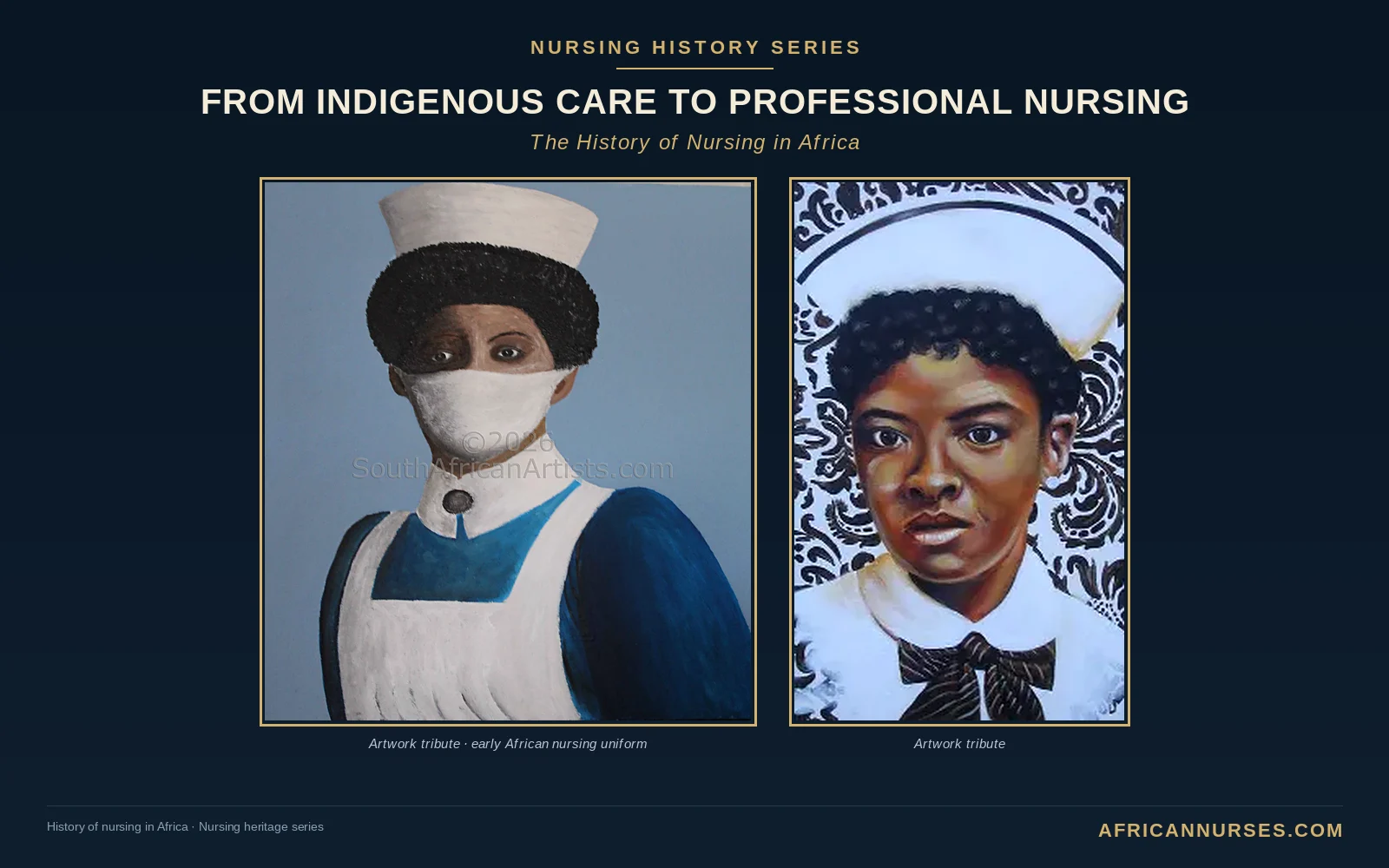
From Indigenous Care to Professional Nursing: The History of Nursing in Africa and Nigeria

Abdullahi Suleiman
September 2, 2026
The history of nursing in Africa began with indigenous healthcare systems, community caregiving and traditional midwifery. Professional nursing later developed through missionary hospitals, colonial healthcare systems, formal education and professional regulation. In Nigeria, key milestones included the 1930 Midwives Ordinance, the 1947 Nursing Council of Nigeria, the growth of nursing education at University College Hospital, Ibadan, and the establishment of the Nursing and Midwifery Council of Nigeria in 1979.
Stories of modern nursing often begin with figures such as Florence Nightingale and Virginia Henderson. However, the history of nursing in Africa began long before nursing became a regulated profession with formal schools, examinations and professional councils.
African communities already had established ways of caring for the sick, supporting women during childbirth and responding to illness. People with specialised knowledge of herbs and roots treated various conditions. Traditional birth attendants supported pregnant women and new mothers, while families and communities provided much of the daily care patients needed.
Over time, these indigenous systems of care encountered new influences, including formal Western healthcare, missionary medicine and colonial administration. From this intersection emerged a new model of nursing that eventually developed into a recognised and regulated profession across much of the continent.
Table of Contents
- Indigenous Healthcare in Africa Before Professional Nursing
- How Professional Nursing Developed in Africa
- South Africa and the Early Growth of Professional Nursing
- The Expansion of Nursing Education Across Africa
- 1930 Midwives Ordinance: A Major Milestone
- The Growth of Nursing Education in Nigeria
- From Colonial Nursing to Nigerian Nursing
- Nursing and Midwifery Council of Nigeria
- How Professional Nursing Has Changed
- FAQs About the History of Nursing in Africa
- Conclusion: The Next Chapter Is Ours to Write
Indigenous Healthcare in Africa Before Professional Nursing
The development of professional nursing in Africa was gradual. Before formal nursing schools existed, healthcare was largely organised within families and communities.
Traditional healers used knowledge of herbs, roots and other natural remedies to treat illness. Traditional birth attendants provided care during pregnancy, labour and the postnatal period.
Families also played a central role in caring for sick relatives. This community-based approach formed an important foundation for healthcare in many African societies.
These systems were not identical across the continent. Practices varied according to local cultures, beliefs, environments and available resources.
How Professional Nursing Developed in Africa
As missionary organisations and colonial governments established hospitals and healthcare services, the demand for trained personnel increased.
Nursing began to move from informal, community-based and apprenticeship-style care towards structured education, examinations, registration and professional standards.
The emerging model was strongly influenced by European nursing, particularly the reforms associated with Florence Nightingale. Her work in nineteenth-century Britain helped establish nursing education as a structured profession.
Nightingale also emphasised sanitation, careful observation, discipline and organised patient care. These ideas later influenced nursing education and hospital practice in parts of Africa.
READ ALSO: Best Nursing Schools in South Africa
Missionary organisations and colonial administrations established hospitals and nursing schools across the continent. British nursing practices became especially influential in British colonies, while French, Portuguese and other European systems shaped nursing in their respective territories.
However, there was no single African nursing story. Each country followed its own path, shaped by local traditions, colonial policies, missionary activity and changing public health needs.
South Africa and the Early Growth of Professional Nursing
South Africa became one of the earliest centres of formal nursing education in Africa.
In 1877, Sister Henrietta Stockdale established a formal nursing training course in Kimberley. Religious organisations also played a major role in developing nursing education through mission hospitals and training institutions.
South Africa became an early centre for professional regulation. In 1891, legislation in the Cape Colony provided for the registration of nurses and midwives, making it an important early step in the statutory regulation of nursing.
This marked an important step towards establishing nursing as a regulated profession.
However, professional nursing developed within the racial inequalities of colonial society. Black nurses faced significant barriers in education, registration and career advancement.
Cecilia Makiwane became the first Black registered professional nurse in South Africa in 1908.
The history of South African nursing therefore reflects two realities: the growth of professional nursing and the social inequalities that influenced access to training and career progression.
The Expansion of Nursing Education Across Africa
Formal nursing education continued to expand across the continent.
In countries such as Ghana and Nigeria, missionary hospitals and government healthcare institutions became important centres for nursing and midwifery training.
Education gradually shifted from apprenticeship-style instruction towards formal curricula, examinations and professional registration.
After African countries gained independence, African nurses increasingly took leadership roles in nursing education, administration and clinical practice.
The focus of nursing also expanded beyond hospital care. Nurses became more involved in public health, community health, health education and disease prevention.
Nursing was no longer being developed solely to support colonial healthcare systems. It was increasingly being shaped to address the health needs of African communities.
Nigeria provides an important example of this transformation.
History of Nursing in Nigeria
The history of nursing in Nigeria is closely connected to missionary activity and the expansion of colonial healthcare.
Christian missionaries introduced and supported healthcare services alongside their religious work. At the same time, the colonial government gradually established hospitals and other medical institutions.
As these services expanded, the demand for trained nurses and midwives grew. Nursing eventually became one of the earliest formally recognised professions in colonial Nigeria.
According to the Nursing and Midwifery Council of Nigeria, nursing was among the first five recognised and accepted professions during the colonial era, with professional recognition transferred from the British home government.
Nursing and midwifery received particular attention because of their direct impact on the health and wellbeing of individuals, families and communities.
This recognition helped accelerate the development of formal nursing and midwifery education in Nigeria.
1930 Midwives Ordinance: A Major Milestone
A significant milestone in the history of nursing in Nigeria came in 1930, when the Midwives Ordinance was introduced.
The ordinance helped regulate midwifery education and practice in the country. It also strengthened the formal structure of maternal and newborn care.
In 1947, the Nursing Council of Nigeria was established through the Registration of Nurses Ordinance.
Its purpose was to regulate nursing education and professional practice.
These developments marked a major shift. Nursing was moving beyond a system in which individual hospitals determined how nurses should be trained.
Formal structures for education, registration and professional standards were beginning to take shape.
The Growth of Nursing Education in Nigeria
As Nigeria’s healthcare system developed, nursing education expanded.
One of the most important milestones was the establishment of University College Hospital (UCH), Ibadan, in 1952, alongside its School of Nursing.
UCH became an important centre for healthcare education and professional training in Nigeria.
At the time, British influence remained strong. Early Nigerian nursing education reflected British standards, curricula and approaches to professional training.
However, Nigerian nurses gradually became more involved in shaping the profession. They took on greater responsibilities in teaching, administration, clinical practice and public health.
Nigeria’s independence in 1960 accelerated this transformation.
From Colonial Nursing to Nigerian Nursing
At independence, Nigeria inherited a healthcare system and nursing structure heavily influenced by Britain.
However, Nigerian nurses increasingly became responsible for determining the future direction of the profession.
Nursing schools expanded, and more Nigerians entered the field. Nurses moved into teaching, administration, public health and specialist clinical practice.
Nursing education also gradually moved beyond hospital-based training towards higher education and university programmes.
This reflected a broader understanding of nursing as a profession requiring advanced knowledge, leadership and critical thinking.
Nursing was no longer simply about producing staff for hospitals. Nurses were becoming educators, researchers, public health practitioners, advocates and healthcare leaders.
READ ALSO: The First Black Nurse to Work in the UK’s NHS: The Story of Chief Kofoworola Abeni Pratt
Nursing and Midwifery Council of Nigeria
In 1979, the Nursing and Midwifery Council of Nigeria was established as the statutory regulatory body for nursing and midwifery in the country.
Today, the Council regulates nursing and midwifery education and practice across Nigeria. It helps maintain professional standards, oversee training and protect the public.
The Council’s work is central to the continued development of professional nursing in Nigeria.
It also supports the transition from traditional and hospital-based training towards a more structured, higher-education-focused profession.
How Professional Nursing Has Changed
The journey from indigenous systems of care to professional nursing has been long and complex.
The history of nursing in Africa has been shaped by traditional knowledge, community care, missionary medicine, colonial healthcare structures, Western nursing education, professional regulation and African leadership.
Today, African nurses work far beyond the traditional image of the hospital bedside.
They are clinicians, researchers, educators, public health professionals, administrators, policymakers, entrepreneurs, advocates and healthcare leaders.
Nigeria reflects this wider evolution. From early community-based systems of care to mission hospitals, from colonial nursing schools to professional regulation, and from hospital-based training to university education, Nigerian nursing has continually developed.
The story is therefore not simply about how Western nursing came to Africa.
It is about how existing systems of care encountered new institutions, how nursing evolved into a profession and how African nurses reshaped that profession to serve their communities.
FAQs About the History of Nursing in Africa
1. How did nursing begin in Africa before it became a formal profession? Long before formal nursing schools existed, healthcare in Africa was organised through families and communities — traditional healers using herbal remedies, traditional birth attendants supporting childbirth, and relatives providing daily care for the sick.
2. Which country was an early leader in professional nursing in Africa? South Africa was one of the earliest centres of formal nursing education, with Sister Henrietta Stockdale establishing a formal training course in Kimberley in 1877, followed by statutory registration of nurses and midwives in the Cape Colony in 1891.
3. Who was the first Black registered professional nurse in South Africa? Cecilia Makiwane became the first Black registered professional nurse in South Africa in 1908, despite the racial barriers Black nurses faced in education and career advancement at the time.
4. What were the major milestones in the history of nursing in Nigeria? Key milestones include the 1930 Midwives Ordinance, the 1947 Nursing Council of Nigeria, the 1952 founding of University College Hospital’s School of Nursing in Ibadan, and the 1979 establishment of the Nursing and Midwifery Council of Nigeria.
5. How did colonialism influence nursing’s development in Africa? Colonial administrations and missionary organizations’ introduced formal hospitals and nursing schools, largely modelled on European, especially British — standards. Over time, particularly after independence, African nurses took increasing control of the profession’s direction and priorities.
Conclusion: The Next Chapter Is Ours to Write
The history of nursing in Africa and Nigeria is a story of continuity, change and resilience.
Professional nursing did not emerge in isolation. It developed alongside existing systems of care and was shaped by missionary organisations, colonial administrations, formal education and post-independence nation-building.
Although early professional structures were largely influenced by European models, African nurses gradually made the profession their own. They expanded its role beyond hospital care into public health, education, research, leadership and community development.
But history should not only tell us where we came from. It should challenge us to decide where we are going.
The next chapter of African nursing cannot be written by history alone. It requires nurses who are willing to lead, educators who are willing to innovate, researchers who will generate evidence that speaks to African realities, policymakers who will listen to the profession, and healthcare institutions willing to invest in the people who keep their systems running.
So, what will your contribution be?
Whether you are a nurse at the bedside, a student preparing to enter the profession, an educator, researcher, policymaker or healthcare leader, you are part of nursing’s next chapter. Learn the history. Understand the progress. Recognise the gaps. And then help build what comes next.
The journey from indigenous care to professional nursing has brought us this far. Now, it is our turn to shape where African nursing goes next.
References
- Dolamo, B. L., & Olubiyi, S. K. (2013). Nursing education in Africa: South Africa, Nigeria, and Ethiopia experiences. International Journal of Nursing and Midwifery, 5(2), 14–21. https://doi.org/10.5897/IJNM11.029
- Nursing and Midwifery Council of Nigeria. (n.d.). History: Origin of nursing in Nigeria. https://nmcn.gov.ng/history.html
- Nursing and Midwifery Council of Nigeria. (n.d.). Establishment of the Nursing and Midwifery Council of Nigeria. https://nmcn.gov.ng/establish.html
- South African History Online. (2020, November 23). Cecilia Makiwane. https://sahistory.org.za/people/cecilia-makiwane
- South African Nursing Council. (2013). Annual report 2013. https://sanc.co.za/wp-content/uploads/2020/06/SANC-Annual-Report-2013.pdf


