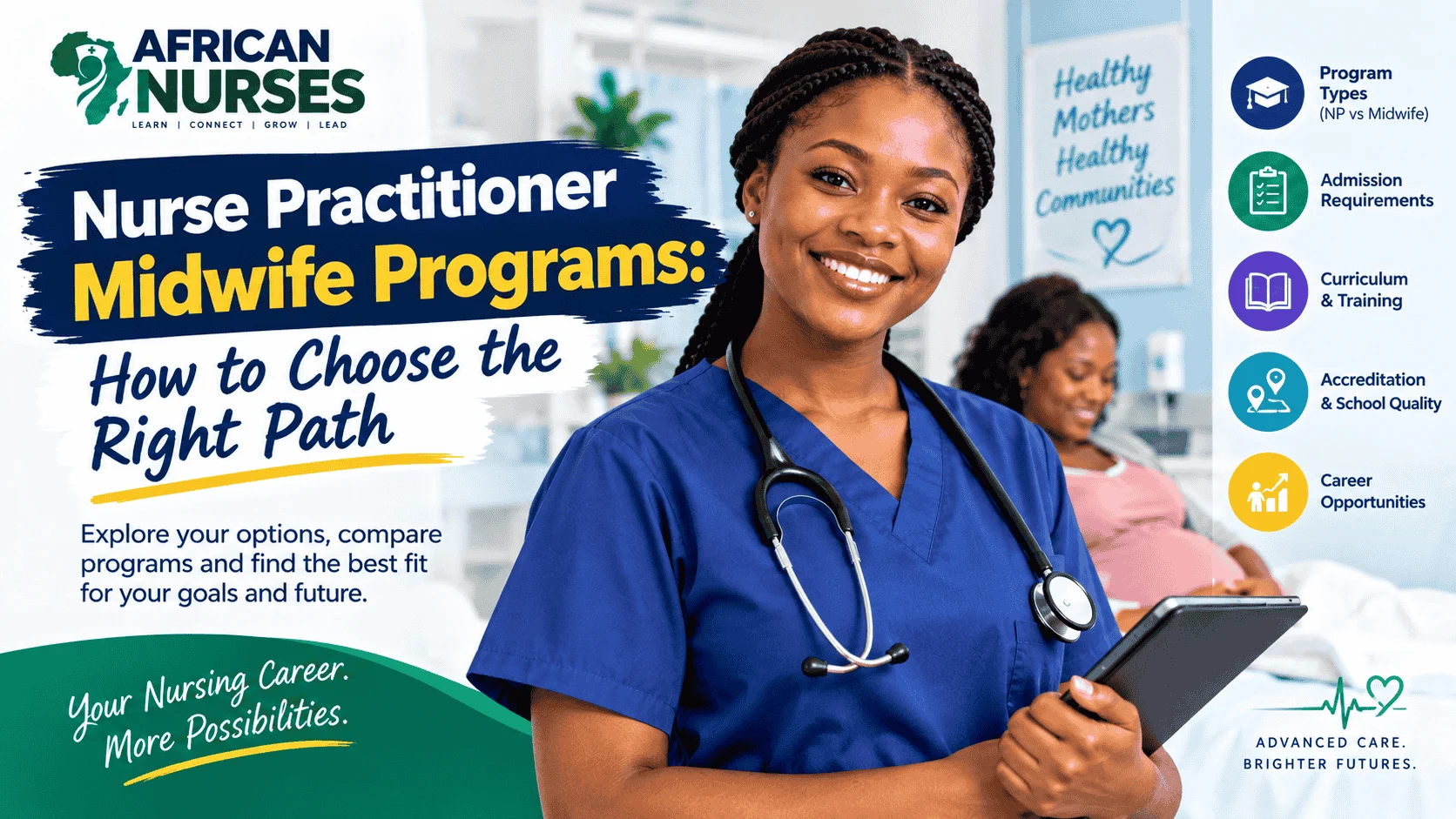
Nurse Practitioner Midwife Programs: How to Choose the Right Path

Abdullahi Suleiman
September 19, 2026
If you are a registered nurse considering graduate study, you have probably already come across both of these paths. Nurse Practitioner Midwife programs are often mentioned together because both lead to advanced practice roles with greater clinical responsibility than traditional bedside nursing.
Although they prepare nurses for more advanced and independent roles, they do so differently, with different scopes of practice, educational requirements, certification pathways, and day-to-day responsibilities.
This guide clearly explains nurse practitioner and nurse midwife programs, so you can understand what each path actually trains you to do before committing years of study to either one.
Note: The accreditation, certification, and workforce information in this guide refers primarily to the United States. Requirements can differ substantially in other countries.
Table of Contents
Nurse Practitioner Midwife Programs
Before we compare the two paths directly, you have to first understand each one on its own terms. Once you know what each role involves, the differences that matter most become easier to understand.
● What a Nurse Practitioner Program Actually Trains You to Do
A Nurse Practitioner (NP) programme prepares registered nurses for advanced clinical practice in a particular patient population or specialty. Depending on the specialty and state, NPs assess patients, diagnose conditions, order and interpret diagnostic tests, prescribe medications, and manage acute and chronic health conditions.
According to the American Association of Nurse Practitioners (AANP), there were more than 461,000 licensed NPs in the United States in 2025. About 87% were educated in programmes focused on primary care.
NP education can lead to different population-focused roles, including family practice, psychiatric mental health, adult-gerontology, paediatrics and women’s health. The appropriate programme therefore depends heavily on the type of patients and clinical problems you want to manage.
Read also: Advanced Nursing Roles: Nurse Practitioner & Specialist Career Paths in Africa
● What a Nurse Midwife Program Actually Trains You to Do
A Nurse Midwife programme focuses specifically on midwifery care, including reproductive health, pregnancy, labour, birth, postpartum, and neonatal care. Nurse-midwives can also provide broader primary and reproductive healthcare across the lifespan.
To become a Certified Nurse-Midwife, a registered nurse must graduate from a program accredited by the Accreditation Commission for Midwifery Education (ACME) and then pass the certification examination administered by the American Midwifery Certification Board (AMCB).
It is also important not to confuse a Certified Nurse-Midwife (CNM), a Certified Midwife (CM), and a Certified Professional Midwife (CPM). All three are different credentials with different educational and certification pathways.
For instance, a CNM is a registered nurse with a graduate degree who can prescribe medication and practice in all 50 states, mostly in hospitals. A CM completes the same graduate education and board exam as a CNM but has a non-nursing background and is licensed in only a few states. Meanwhile, a CPM is a direct-entry practitioner who does not need a nursing degree and trains specifically to manage out-of-hospital births like home births and birth centers.
AMCB identifies the CNM and CM credentials as its certifications, while the CPM credential is administered by the North American Registry of Midwives (NARM).
For a registered nurse specifically interested in advanced practice involving pregnancy, birth, and reproductive health, the CNM pathway is the relevant midwifery route discussed in this guide.
Related: Top 7 Nursing Specializations That Boost Your Career in Africa
Nurse Practitioner vs Nurse Midwife: What Is the Difference in Practice?
The biggest practical difference is the type of care each role is prepared to provide.
An NP’s day-to-day work depends on their chosen population or specialty. A Family Nurse Practitioner, for example, may assess patients with acute illnesses, manage chronic conditions such as hypertension and diabetes, provide preventive care, order diagnostic tests, and prescribe treatments. A Psychiatric-Mental Health Nurse Practitioner focuses instead on assessing and managing mental health conditions.
A Nurse Midwife has a more specialised focus on reproductive and maternity care. Depending on their scope of practice and practice setting, their work may include prenatal assessments, supporting patients through labour and birth, postpartum care, contraception, reproductive health services and newborn care.
The work environments of both careers can overlap, but the clinical focus is different. NPs may practise in primary care clinics, hospitals, outpatient centres and specialty practices, while nurse-midwives commonly work in hospitals, birth centres, clinics and other settings providing maternity or reproductive healthcare.
It is important to consider these differences before applying because the programme you choose will shape the patient populations, clinical experiences, and type of advanced practice you are prepared to pursue.
Accreditation for Nurse Practitioner and Nurse Midwife Programs
Accreditation is one of the most important things to check before applying because the accreditation pathway for NP education is different from that for nurse-midwifery education.
For Nurse Practitioner programmes, the American Association of Nurse Practitioners identifies the following three national nursing accreditors (the first two are the most prominent):
- Commission on Collegiate Nursing Education (CCNE)
- Accreditation Commission for Education in Nursing (ACEN)
- National League for Nursing Commission for Nursing Education Accreditation (CNEA)
Before enrolling, confirm which national certification the programme prepares you for and whether the programme’s population focus, curriculum, clinical training and accreditation meet the current eligibility requirements of the relevant certification board. For example, if you want to become a Family Nurse Practitioner, verify that the programme specifically prepares graduates for the Family Nurse Practitioner certification rather than assuming that any NP programme will qualify you.
For Nurse Midwifery programmes, accreditation works differently. ACME accredits graduate-level midwifery programmes, and graduates of an accredited programme who meet the other requirements can become eligible for the AMCB certification examination. The American College of Nurse-Midwives currently lists 46 U.S. midwifery education programmes that are accredited or pre-accredited by ACME.
This means that an NP applicant and a nurse-midwifery applicant need to check different accreditation requirements when researching schools. Do not assume that accreditation for one pathway automatically qualifies you for the other.
Dual Programs: When You Do Not Have to Choose Just One
If you are genuinely interested in both paths, dual programmes do exist.
For example, the University of Utah College of Nursing offers a dual Women’s Health Nurse Practitioner/Nurse-Midwifery track. The programme prepares graduates for both women’s health NP and nurse-midwifery practice and includes clinical education in areas such as reproductive health, pregnancy, birth and newborn care.
Georgetown University also offers a dual Nurse-Midwifery/Women’s Health Nurse Practitioner programme. Its current programme consists of 49 credits, more than 1,000 clinical hours and 27 months of part-time study.
A dual pathway may make sense if your long-term career genuinely involves both women’s primary healthcare and midwifery care. However, it also means meeting the educational and certification requirements for two roles, so it may require more training than choosing a single pathway.
If you are only mildly interested in one of the two roles, a one-focused programme may be more appropriate than taking on both sets of requirements.
Demand and Career Outlook for Nurse Practitioners and Nurse Midwives
Both careers are projected to grow in the United States, although the projected growth rates and total employment levels vary.
The U.S. Bureau of Labor Statistics projects Nurse Practitioner employment to grow by 41% between 2025 and 2035, from about 336,300 jobs to 474,100.
For Nurse Midwives, employment is projected to grow by 11% over the same period, from about 8,200 jobs to 9,100. That represents approximately 900 additional positions.
Both figures represent possible, faster-than-average growth. However, the larger NP estimate partly reflects how much broader the Nurse Practitioner field is as a whole, spanning many specialties, compared to the more narrowly defined Nurse Midwife role.
Also note that the figures describe the U.S. labour market and should not be interpreted as forecasts for nursing employment in Africa or other countries.
Related: How to Increase Your Certified Nurse Midwife Salary
What to Check Before You Apply
Once you understand which pathway fits your goals, check the following before applying:
- Confirm accreditation: Check the accrediting body’s current records rather than relying only on information published by the school. For NP programmes, check the relevant nursing accreditation and certification requirements. For nurse-midwifery programmes, verify ACME accreditation or pre-accreditation.
- Check recent certification outcomes: Look at certification examination performance for recent graduating classes. Consider several years of results where available rather than relying on one unusually strong or weak year.
- Ask about clinical placements: This is particularly important for online or distance-based programmes. Find out whether the school arranges clinical placements or expects students to secure them independently.
- Check the total cost: Confirm current tuition, fees and other programme costs directly with the university. Costs can vary according to residency, programme format and other factors.
- Check the certification pathway: Before enrolling, confirm exactly which certification the programme prepares you for and whether its curriculum meets the current requirements of the relevant certification board.
Conclusion
Nurse Practitioner Midwife programs are related advanced nursing pathways, but they prepare graduates for different types of clinical practice.
A Nurse Practitioner programme offers several specialty options, allowing nurses to focus on areas such as family practice, mental health, adult-gerontology or paediatrics. A Nurse Midwife programme focuses more specifically on reproductive health, pregnancy, labour, birth, postpartum care, and related primary care.
Understanding these differences before applying can help you avoid choosing a programme simply because it sounds similar to the career you want. Check the curriculum, accreditation, certification pathway, clinical requirements, and cost, then choose the programme that matches the type of practice you actually want to pursue.