
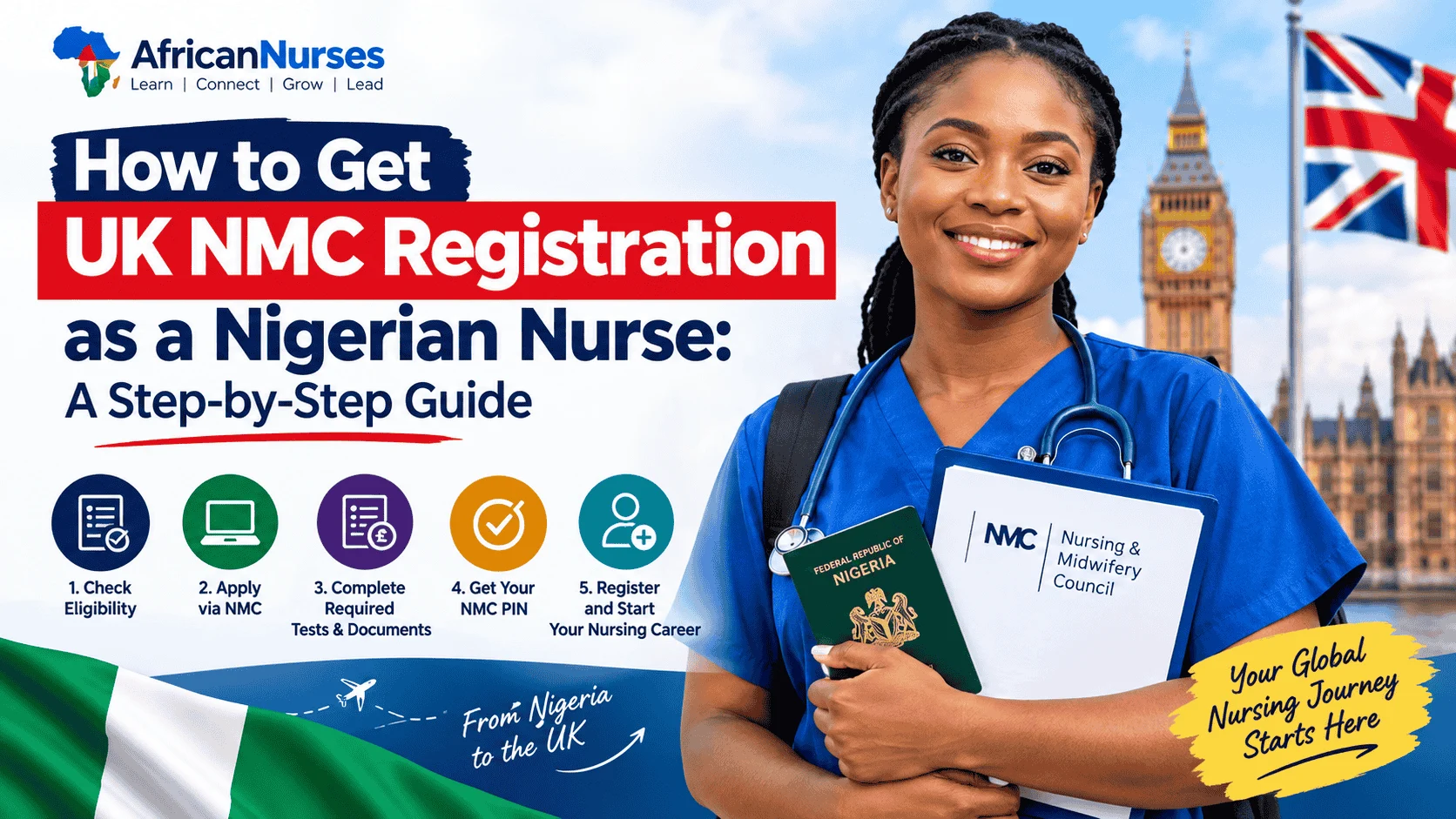
How to Get UK NMC Registration as a Nigerian Nurse: A Step-by-Step Guide

Abdullahi Suleiman
September 26, 2026
If you are a Nigerian nurse planning to work in the UK, one of the first things you need to do is register with the Nursing and Midwifery Council (NMC). However, knowing you need NMC registration and knowing how to get itare two different things.
The process involves qualification checks, English-language evidence, the Test of Competence, health and character requirements, and several stages of document verification. Getting the sequence right can save you unnecessary delays and expenses.
This guide explains how to get UK NMC registration as a Nigerian nurse, using the NMC’s current requirements for nurses trained outside the UK. Because fees and requirements can change, always confirm the latest information with the NMC before submitting an application or paying for a test.
Table of Contents
How to Get UK NMC Registration as a Nigerian Nurse
Before getting into the steps, there is one important distinction to understand.
NMC UK Is Not the Same as NMCN
NMCN is the Nursing and Midwifery Council of Nigeria, while the NMC is the Nursing and Midwifery Council of the United Kingdom. They are separate regulators with separate registration systems.
Being registered with NMCN does not automatically give you registration with the UK NMC. If you trained in Nigeria or other parts of Africa and want to join the UK register, you need to apply through the NMC’s trained outside the UK registration route and meet its requirements.
5 Steps to Get UK NMC Registration as a Nigerian Nurse
1. Create Your NMC Account and Meet the English-Language Requirement
The first stage is to check that you are eligible for the overseas registration route and create your online NMC account. You will provide identity, qualification, and registration information as part of the eligibility and qualification application.
You also need to provide evidence that you have the necessary knowledge of English to practise safely and effectively in the UK.
This does not automatically mean taking IELTS or OET. The NMC accepts three broad types of evidence. They are:
- An accepted English-language test
- A qualifying pre-registration nursing or midwifery programme taught and examined in English, or
- A recent registered practice in a majority English-speaking country.
If you want to use the English-Language test, the NMC currently accepts IELTS Academic and OET. The required scores are:
- IELTS: 7 in listening, reading and speaking, and 6.5 in writing.
- OET: B (350 or above) in listening, reading and speaking, and C+ (300 or above) in writing.
If you, however, want to use your nursing education as evidence of English instead of taking a test, check the NMC’s detailed guidance carefully since additional evidence may be required for applicants trained in countries that are not on the NMC’s majority-English-speaking-country list.
2. Submit Your Qualification and Registration Information
Following account creation, you will need to provide evidence of your nursing qualification and professional registration. The NMC asks for a copy of your original qualification certificate and will contact your regulator to confirm that the qualification allowed you to register in the country where you trained.
This is where your Nigerian nursing documentation becomes important. Make sure your qualification and registration details are accurate and that the relevant institutions and referees know that the NMC may contact them.
The NMC recommends contacting your verifiers before beginning the application so they know to expect requests from the regulator. Delays can occur if the NMC is waiting for information from a referee or verifier.
Also note that you will pay a £140 qualification evaluation fee at this stage. The NMC states that this fee is non-refundable.
Once the NMC has received the necessary information from your regulator and training institution, it aims to assess your qualification within 14 days.
3. Complete the Test of Competence
If the NMC confirms that you are eligible and requires you to demonstrate your competence, you will need to complete the Test of Competence (ToC).
The ToC has two parts:
- Computer-Based Test (CBT): a computer-based assessment of nursing knowledge.
- Objective Structured Clinical Examination (OSCE): a practical examination assessing clinical and communication skills.
You do not have to take them in a particular order. The NMC allows applicants to complete the CBT and OSCE in either order, but both must be passed if they are required for your application.
The current CBT fee is £83 for the first sitting, while the OSCE costs £794 for the first sitting. A full OSCE resit costs £794, while a partial resit covering up to seven failed stations costs £397.
The CBT can be taken outside the UK through approved test centres. These approved centres can be found in various African countries, including Lagos, Nigeria; Nairobi, Kenya; and Accra, Ghana. For more details on the CBT centres, check the Pearson website.
The OSCE, however, is a practical examination held only at approved UK test centres.
4. Complete Your Registration Application
Passing the ToC is not the final step. You still need to complete the rest of your registration application.
The NMC requires evidence relating to:
You will also need to provide the required supporting information and allow the NMC to verify it with your nominated referees.
Professional indemnity is a specialized form of professional malpractice insurance tailored for healthcare workers. For you to practice in the UK, you must have an appropriate indemnity arrangement. You do not necessarily have to purchase an individual policy yourself; depending on your employment, your employer may provide the appropriate cover.
Also note that there is a face-to-face identity check as part of the overseas registration process, where the NMC verifies original documents.
5. Pay the Registration Fee and Wait for the NMC Decision
Once you have completed the required parts of your application, you will pay the registration fee and submit your application.
As of 23 September 2026, the registration fee is £153, but the NMC has announced that it will increase to £182 for applications opened from 1 October 2026.
After paying and submitting your application, the NMC then verifies the information it has received and considers your application. Note that application consideration may take up to 35 days. Just ensure NMC has received the necessary supporting health, character and language evidence, applicable CBT and OSCE results, and registration fee.
If the application is successful, you will be added to the NMC register and receive your NMC registration details, including your PIN.
Related: Ethical Migration for African Nurses: Navigating the 2026 WHO Red List
What Does UK NMC Registration Cost?
The cost depends partly on when you apply.
As of 23 September 2026, the NMC lists the total cost of the required fees and tests at £1,170. This includes:
- Qualification evaluation: £140
- CBT: £83
- OSCE: £794
- Registration: £153
This total cost does not include IELTS/OET costs, visa fees, flights, accommodation, travel within the UK or any preparation courses.
From 1 October 2026, the NMC says the total will increase to £1,226, because the qualification evaluation fee will rise from £140 to £167 and the registration fee from £153 to £182.
You should also budget for possible resits because the total will be higher if you do not pass a required test on your first attempt.
How Long Does UK NMC Registration Take?
There is no single timeline that applies to every Nigerian nurse because much depends on how quickly your evidence is provided, how long you need to prepare for the CBT and OSCE, and whether you need to repeat either test.
The NMC says it aims to assess your qualification within 14 days once it has received the required information from your regulator and training institution. After your eligibility is confirmed, you have two years to complete your registration.
The NMC also advises applicants to make sure they are ready to actively progress their application before creating an account. Applications with no further activity for three months may be closed.
What Nigerian Nurses Should Know About the OSCE
Unlike the CBT, the OSCE must be taken at an approved UK test centre. As of September 2026, the NMC lists three approved OSCE providers for nurses and midwives:
- University of Northampton
- Ulster University
- Leeds Teaching Hospitals NHS Trust
Two previous centres, namely Oxford Brookes University and Northumbria University’s centre, closed on 31 July 2026 and 19 February 2026, respectively.
This means you should check the NMC’s current list of approved centres before making travel arrangements rather than relying on older guides or recruitment posts.
Conclusion
How to get NMC registration as a Nigerian nurse starts with understanding that NMC UK and NMCN are separate regulators. From there, the process involves establishing your eligibility, providing qualification and registration information, meeting the English-language requirement, completing the Test of Competence where required, submitting your health and character evidence, and completing the final registration stage.
The costs and requirements can change, so use this article as a guide to understanding the process rather than a substitute for checking your individual eligibility with the NMC.
Before paying for a test, travelling to the UK or submitting your application, check the NMC’s official overseas registration guide for the requirements that apply to your circumstances.


