The Story of Oluchi Angel Okoi: The Nigerian Nurse Bringing Forensic Nursing Into the Fight for Justice

Abdullahi Suleiman
21/09/2026
What happens when patient is a victim of sexual violence and the evidence collected during a clinical examination could become part of a criminal investigation?
Sometimes, a nurse has to step beyond caring for the survivor to help a court understand what happened. For Nigerian nurse Oluchi Angel Okoi, this question became part of her work.
With 19 years of clinical experience, Okoi has built a career around caring for survivors of sexual and gender-based violence, forensic examination, evidence documentation and medico-legal practice.
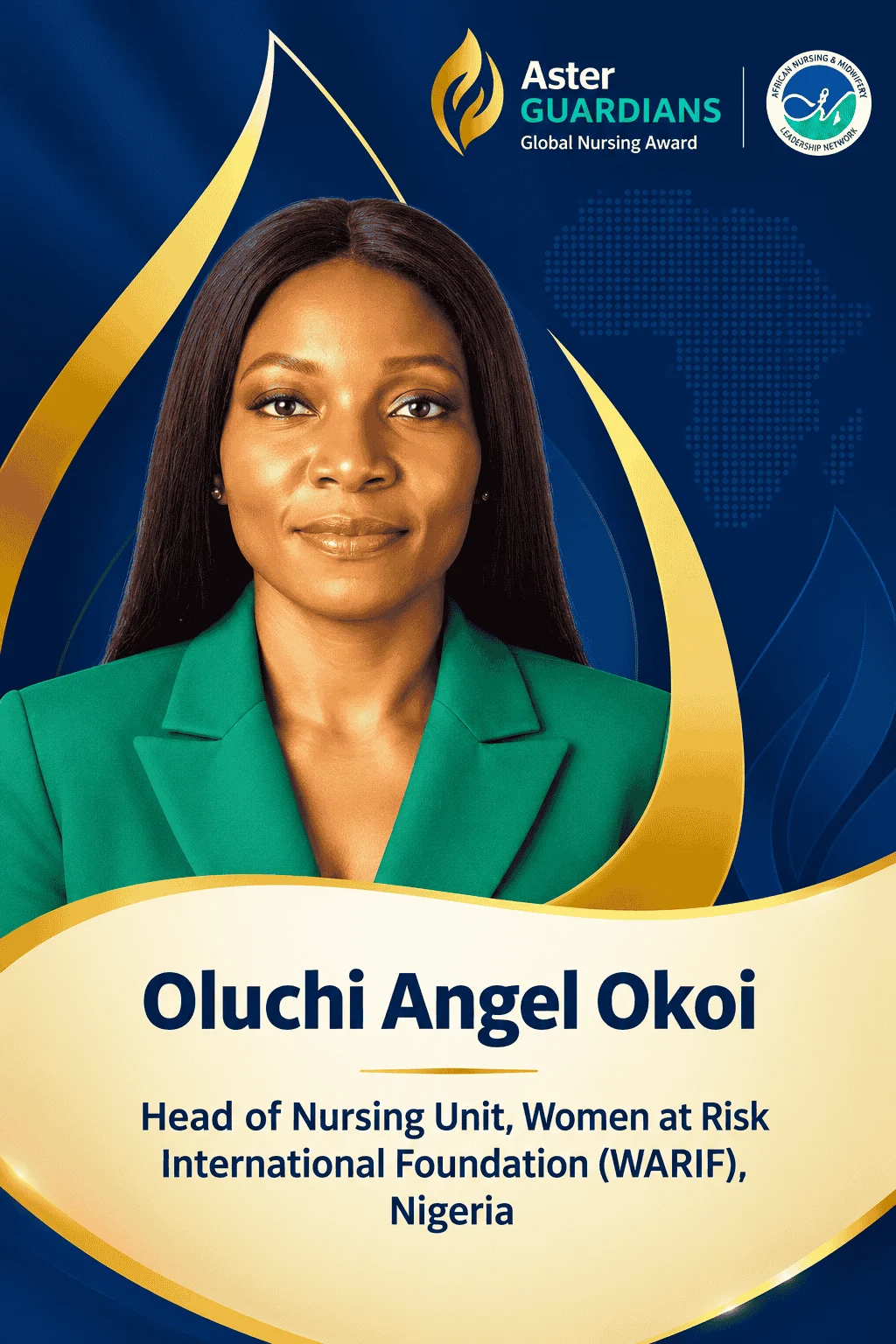
In 2026, her work took her to a global stage when she was named one of the Top 10 finalists for the Aster Guardians Global Nursing Award, selected from more than 134,000 registrations across 214 countries and economies.
But the recognition is only one chapter of her story.
From Clinical Nursing to Forensic Care
Okoi’s journey into trauma care was shaped by what she saw around her. She has described seeing the “silent pain” carried by women and children who had experienced sexual and gender-based violence.
For her, treating these survivors required more than addressing physical injuries. They needed someone who would listen. Someone who would believe them. Someone who could document their experiences accurately and support them through a system where healthcare and justice often intersect. That realisation became an important part of her professional journey.
Today, her work includes trauma-informed care, forensic and medical examinations, documentation of evidence, medico-legal processes and expert witnessing. It is a form of nursing that many people may not immediately associate with the profession.
But it demonstrates just how far nursing knowledge can extend beyond traditional bedside care.
Where Nursing Meets the Justice System
Forensic nursing sits at an unusual intersection. The nurse is still caring for a person, but the clinical encounter can also have implications for an investigation and a legal case.
This means that how a nurse examines a survivor, documents findings, preserves evidence and communicates clinical information can matter far beyond the hospital or crisis centre.
Okoi has worked in this space at the Women at Risk International Foundation (WARIF), where she has been involved in caring for survivors of sexual and gender-based violence. WARIF’s current team listing identifies her as a Senior Nursing Officer.
Her work has also included training healthcare professionals and law-enforcement personnel in areas related to forensic documentation and survivor-centred care. She has served as an expert witness in legal proceedings, bringing a nurse’s clinical perspective into the courtroom.
This is where her career challenges a common picture of what nurses do. The nurse is not only caring for the body. The nurse may also be helping preserve evidence, protect a survivor’s dignity, communicate clinical findings and contribute to the pursuit of justice.
The Case That Stayed With Her
One of the cases Okoi has spoken about involved nine child survivors. Through detailed forensic documentation, appropriate evidence preservation and professional testimony in court, the medical findings became part of the legal process. The case eventually resulted in a conviction.
For Okoi, the significance went beyond the outcome in court. It demonstrated what can happen when nursing care is connected to systems of justice. A nurse’s documentation can become evidence.
A nurse’s testimony can help explain medical finding and her approach to a survivor can influence whether that person feels safe enough to disclose what happened and continue receiving care. In this sense, forensic nursing is not separate from compassion. It requires both clinical precision and humanity.
The Recognition That Took Her Work Global
On 12 May 2026, International Nurses Day, Okoi was announced as one of the Top 10 finalists for the fifth Aster Guardians Global Nursing Award. She was selected from more than 134,000 registrations across 214 countries and economies.
Her selection placed a relatively specialised area of nursing on an international platform.
The Aster Guardians profile highlighted her work integrating trauma-informed clinical care with forensic and legal processes in the response to sexual and gender-based violence. It also noted her work training nursing teams in forensic documentation and courtroom preparation, as well as her role as an expert witness.
She became the Nigerian representative among the ten global finalists.
The award ultimately went to Dr. Agimol Pradeep of the United Kingdom, but Okoi finished the competition among the global Top 10. For Nigerian nursing, however, the significance of her journey extends beyond the award result.
Her story brought attention to a field of nursing that remains relatively unfamiliar to many nurses and nursing students.
A Different Picture of What a Nurse Can Become
There is a tendency to think of nursing careers in a straight line. Nursing school. Hospital. Ward. Senior nurse. Perhaps management. But nursing can take people into places that are not immediately obvious from the classroom. Forensic nursing is one of them.
Okoi’s career demonstrates how clinical nursing knowledge can become useful in other systems, including the legal system. It also shows why nurses need opportunities to develop specialised expertise.
A nurse who understands trauma, forensic documentation, evidence preservation, communication and medico-legal processes can contribute in ways that extend beyond routine clinical care.
And perhaps that is one of the most interesting things about Okoi’s story. She did not leave nursing to make an impact elsewhere. She expanded what nursing could mean within her area of practice.
What Her Story Means for African Nurses
Across Africa, nurses are often encouraged to think about their careers primarily through the lens of available hospital jobs. But there are fields within nursing that many students may never encounter until much later, fields like forensic nursing.
Nurses can work at the intersection of healthcare and law. They can contribute to research, policy, education, advocacy, public health, technology and other areas while still drawing from the knowledge and skills developed through nursing.
Okoi’s story is a reminder to look more closely at the problems that need solving. Sexual and gender-based violence is not only a social issue. It is also a healthcare issue, a psychological issue, a public health issue and in many cases, it is a legal issue. That complexity creates space for nurses.
Not because nurses should do everything, but because their clinical perspective can be valuable in systems that need a deeper understanding of survivors and their care.
The Work Continues Beyond the Award
Even before the global recognition, Okoi’s focus had been clear: improving care for survivors and strengthening the role of nurses in forensic practice.
Speaking about the Aster Guardians recognition, she said that regardless of the final outcome, her mission was to continue advocating for survivors, strengthening forensic nursing practice, mentoring younger nurses and contributing to systems that improve access to justice and healing.
That may be the most important part of her story. The award did not create the work. It simply gave the work a larger audience.
Oluchi Angel Okoi’s journey shows that nursing can occupy spaces many people do not immediately associate with the profession. A nurse can care for a survivor, document evidence, stand in a courtroom, train other professionals, advocate for better systems, and help connect the clinical encounter to the pursuit of justice.
Her story, therefore, is not only about becoming one of the world’s Top 10 nurses, but also about expanding the possibilities of what nursing can look like as African Nurses.
It is about what happens when a nurse recognizes a gap, develops the expertise to fill it and continues doing the work long enough for the world to notice.
You do not always have to leave nursing to discover a different career. Sometimes, you have to look deeper into nursing itself.
References
Aster Guardians Global Nursing Award. (2026). Global nursing award. https://www.asterguardians.com/
Aster Guardians Global Nursing Award. (2026). Top 10 finalists 2026. https://www.asterguardians.com/top-10-finalists-2026/
Fellow Nurses Africa. (2026, May 13). Aster Guardians Award 2026: Nigerian nurse Oluchi Okoi emerges Top 10 finalist. https://www.fellownurses.com/2026/05/aster-guardians-award-2026-nigerian-nurse-oluchi-okoi-emerges-top-10-finalist.html
Reuters. (2026, May 12). Aster Guardians Global Nursing Award announces top 10 finalists for 2026 from 134,000+ registrations. Zawya. https://www.zawya.com/en/press-release/companies-news/aster-guardians-global-nursing-award-announces-top-10-finalists-for-2026-from-134000-registrations-zawcb7npd
Women at Risk International Foundation. (n.d.). Team members. https://warifng.org/team-members/
Women at Risk International Foundation. (n.d.). WARIF team at 10th anniversary of Breast Cancer Awareness Run tagged #MoreThanARun. https://warifng.org/warif-team-at-10th-anniversary-of-breast-cancer-awareness-run-tagged-morethanarun/