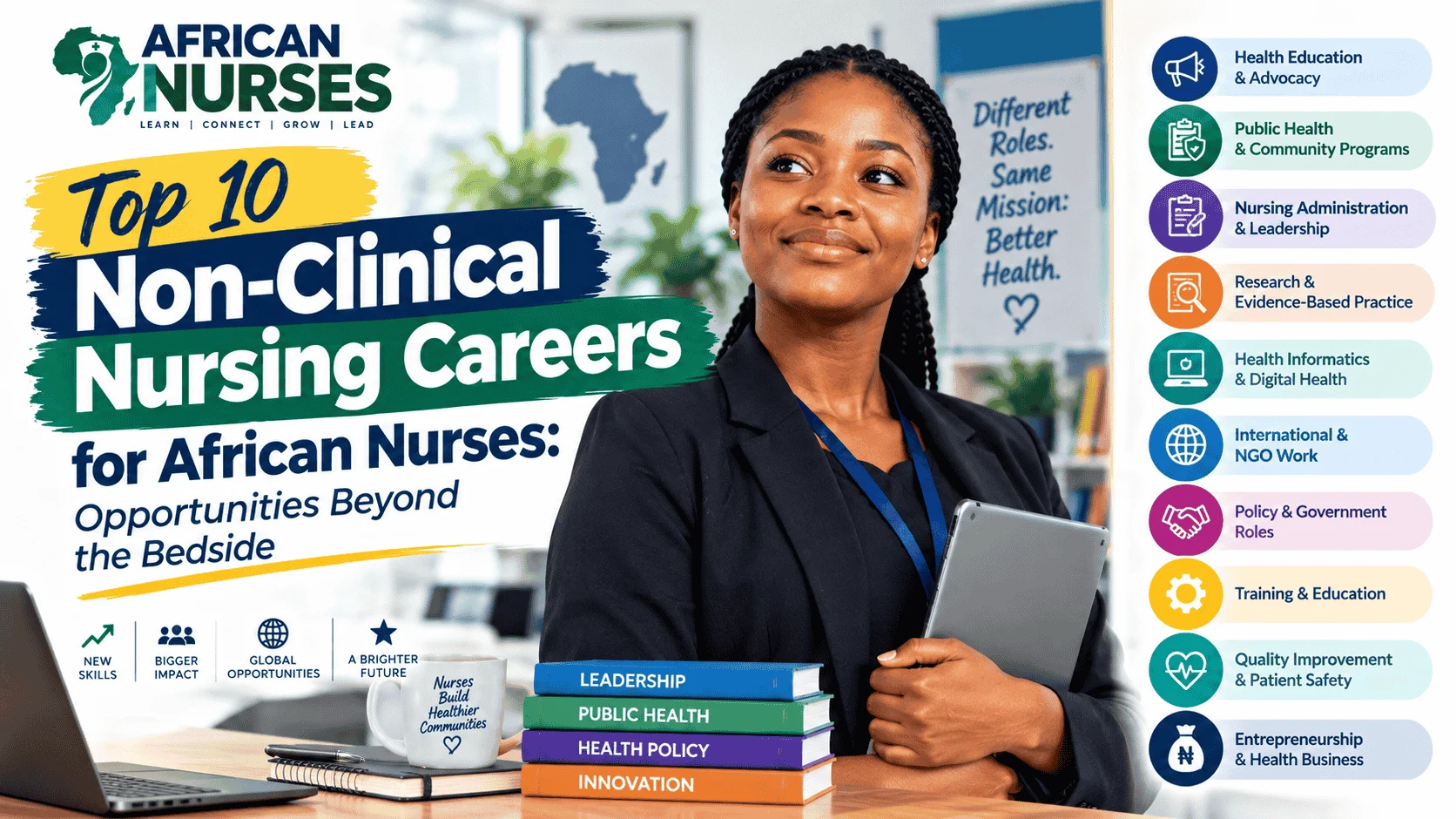
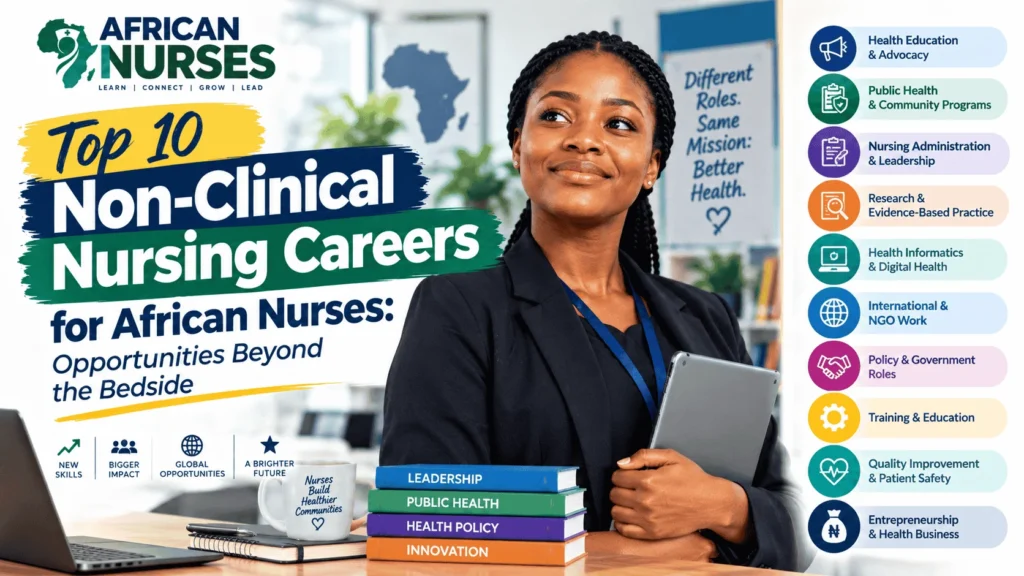
Top 10 Non-Clinical Nursing Careers for African Nurses: Opportunities Beyond the Bedside

Abdullahi Suleiman
September 19, 2026
When you hear the word “nurse,” what comes to mind? you might picture hospital wards, scrubs, medication rounds, night shifts and emergency care. But nursing doesn’t have to mean working at the bedside.
The World Health Organization describes nurses as the largest occupational group in the global health workforce. It’s 2025 State of the World’s Nursing report also highlights education, leadership, workforce development and advanced roles as priorities for strengthening nursing.
This is particularly relevant to Africa. The WHO’s 2026 report on the health workforce in Africa highlights the continent’s changing population and disease patterns, financing constraints and health-worker challenges. It also emphasises the importance of workforce development, data, leadership and investment.
As a result, healthcare systems need nurses not only to provide direct patient care, but also to contribute to research, healthcare technology, education, programme management, health communication, policy and quality improvement.
These non-clinical nursing careers for African Nurses do not mean abandoning nursing. In many cases, they allow nurses to take the knowledge gained from clinical practice and apply it to a different part of the healthcare system.
Table of Contents
- List of Non-Clinical Nursing Careers for African Nurses
- 1. Clinical Research Nurse or Research Coordinator
- 2. Nursing Informatics and Digital Health
- 3. Medical and Health Content Writing
- 4. Health Communications and Advocacy
- 5. Public Health Programme Roles
- 6. Healthcare Quality Improvement
- 7. Healthcare Project Management
- 8. Health Policy and Advocacy
- 9. Pharmaceutical and Medical Device Roles
- 10. Pharmacovigilance and Drug Safety
- Nursing Is Not the Skill. It Is the Foundation.
List of Non-Clinical Nursing Careers for African Nurses
So, what non-clinical nursing jobs and career paths are available, and how can African nurses begin to explore them?
1. Clinical Research Nurse or Research Coordinator
Clinical research is one of the most direct ways to use your nursing knowledge outside routine bedside care.
Research nurses and clinical research coordinators support clinical trials and other studies. Depending on the project, they may recruit participants, collect data, coordinate study visits, maintain research documentation and ensure that study procedures follow approved protocols.
This is particularly relevant in Africa, where locally generated research is needed to inform healthcare decisions.
To enter this field, learn research methodology, research ethics and Good Clinical Practice (GCP). Look for research assistant, study coordinator and clinical research positions at teaching hospitals, universities, research institutes and research organisations. You can also approach researchers whose work interests you and ask about opportunities to assist with ongoing projects.
2. Nursing Informatics and Digital Health
Nursing informatics combines nursing, information and technology. It can involve helping hospitals implement electronic health records, improving digital workflows, training healthcare workers to use health information systems or evaluating whether a technology actually works for clinical users.
You do not have to become a software developer.
Start by learning Excel and basic data skills, then explore health informatics, electronic health records and digital health. Health-tech companies, hospitals, NGOs and organisations implementing digital health programmes can all be potential employers.
Your advantage as a nurse is that you understand the clinical problems technology is supposed to solve.
READ ALSO: Nurses Uniform in Nigeria: The Official NMCN Rules Every NURSE should knows
3. Medical and Health Content Writing
If you enjoy writing, this is one of the most accessible ways to combine nursing with a creative skill.
Medical writers create patient education materials, health articles, research summaries, professional education materials, website content and other healthcare communications.
You do not need to be a bestselling writer to begin. You need to understand evidence and communicate it clearly.
Start by writing. Build three to five strong samples covering different types of healthcare content and publish them on LinkedIn, Medium, Substack or a personal portfolio. Then search for roles such as medical writer, healthcare writer, medical content writer and health communications specialist.
Your nursing qualification gives you subject knowledge. Writing is the skill you build around it.
4. Health Communications and Advocacy
Healthcare organisations need people who can translate complicated medical information into messages that patients and communities can actually understand.
Health communications can include public health campaigns, patient education, social media, advocacy, community engagement and stakeholder communications.
A nurse who understands both healthcare and communication can work with NGOs, health organisations, healthcare brands, media platforms and public health programmes.
Learn health communication, storytelling, content strategy and basic digital media. Then demonstrate your skills by creating health campaigns or educational content rather than simply listing “communication” on your CV.
5. Public Health Programme Roles
Nurses can work beyond clinical services in public health programmes covering areas such as maternal and child health, HIV, tuberculosis, immunisation, mental health and community health.
Programme roles may involve coordinating activities, supporting implementation, training teams, communicating with stakeholders and preparing programme reports.
An MPH can be useful for some positions, but it is not the only way to start. Experience in project coordination, public health initiatives, community programmes or NGO work can help you build relevant experience.
Look beyond hospitals when job hunting. NGOs, public health institutes, government programmes, universities and international development organisations employ people to deliver healthcare programmes.
6. Healthcare Quality Improvement
Quality improvement focuses on making healthcare services safer, more effective and more efficient.
A nurse working in quality improvement may be involved in clinical audits, patient safety, infection prevention, incident reporting, quality indicators, accreditation and improving healthcare processes.
This can be a natural transition for nurses who enjoy asking, “How can we make this system work better?”
Start by participating in clinical audits, quality-improvement projects or patient-safety initiatives in your workplace. Learn basic tools such as PDSA cycles, root-cause analysis and process mapping, and document the projects you contribute to.
7. Healthcare Project Management
Healthcare projects need people who can coordinate teams, timelines, communication, risks and deliverables.
That could mean managing a community health project, digital-health implementation, research project, training programme or health campaign.
Nurses already use many transferable skills: prioritisation, teamwork, coordination, communication and problem-solving. What you may need to add is formal project-management knowledge.
Start by managing something small. A health campaign, community project or professional initiative can become evidence of your ability to manage projects.
Learn project planning, stakeholder management, budgeting and risk management, then search for healthcare project coordinator, programme coordinator and project officer roles.
8. Health Policy and Advocacy
Nurses are among the professionals closest to what happens inside healthcare systems, yet their voices are not always represented in policy conversations.
Health policy work can involve research, policy analysis, advocacy, stakeholder engagement and contributing to policy documents.
You do not have to start by getting a master’s degree in public policy.
Pick one healthcare issue you care about. Read the existing policy, understand the evidence and identify the gaps. Write about what you learn. Participate in professional associations, health advocacy initiatives and policy conversations.
Over time, you can build the research and policy-analysis skills required for more formal roles.
READ ALSO: HOW to renew your nursing licence in nigeria
9. Pharmaceutical and Medical Device Roles
Pharmaceutical and medical-device companies also need people who understand healthcare and can communicate clinical information.
Depending on the organisation and position, nurses may work in clinical education, medical affairs, clinical research, patient-support programmes, product education or commercial roles.
Requirements vary considerably, so read the job description carefully rather than assuming your nursing qualification automatically qualifies you.
If this interests you, choose a therapeutic area and become knowledgeable about the disease, treatments, clinical guidelines and patient journey. Add communication, presentation and research skills.
10. Pharmacovigilance and Drug Safety
Pharmacovigilance focuses on monitoring and evaluating the safety of medicines, including adverse drug reactions and other safety information.
A nurse’s familiarity with medications, patient histories and clinical documentation can be useful in this field.
Look for roles such as pharmacovigilance associate, drug safety associate or safety case processor. Learn adverse-event reporting, medical terminology, drug-safety concepts and regulatory processes.
Because requirements vary between countries and employers, check the specific qualifications and experience requested for each position.
Nursing Is Not the Skill. It Is the Foundation.
One of the biggest mistakes nurses make when exploring non-clinical careers is thinking they need to start from zero. You don’t.
Think of your nursing qualification as domain expertise and then add another skill.
Nursing + Research, Nursing + Writing, Nursing + Technology, Nursing + Communications, Nursing + Policy, Nursing + Project Management, Nursing + Business
These combinations can create career paths that are difficult to see when your only search term is “nursing job.”
How African Nurses Can Actually Start
Knowing that these careers exist is not enough. You need a way into them.
- Stop searching only for “nurse jobs”
Search for the function rather than the profession. Instead of only searching for “Registered Nurse,” try clinical research coordinator, health communications officer, medical writer, digital health associate, project coordinator, quality improvement officer, pharmacovigilance associate and similar titles.
This exposes you to opportunities that may never contain the word “nurse.” Pick one skill. You do not need 15 certificates.
If you are interested in research, learn research methodology and Good Clinical Practice (GCP). If you want health communications, develop medical writing and content strategy. If digital health interests you, learn health informatics and basic data skills. If you want programme work, learn project management and public health fundamentals.
Choose a direction and go deeper.
- Build evidence
Don’t wait for someone to give you a job before you demonstrate the skill.
If you want to write, build a writing portfolio. If you want to manage projects, manage one. If you want to work in research, volunteer on a research project. If you want health communications, create a campaign. Certificates tell people what you studied. Projects show people what you can do.
- Look beyond hospitals
Universities, research institutes, NGOs, health-tech companies, pharmaceutical companies, government agencies, public health organizations’ and healthcare brands are all part of the healthcare ecosystem.
Africa CDC, for example, recruits across a range of technical, programme and public-health functions. Your next healthcare job may not have “hospital” anywhere in its description.
READ ALSO: Upgrade From Nursing Diploma to BNSc
Don’t Romanticise Non-Clinical Careers
Moving away from the bedside does not automatically mean less stress, more money or better work-life balance.
You can burn out in research. You can have difficult managers in a corporate organisation. A remote job can still be demanding. Some non-clinical positions require postgraduate qualifications or several years of experience.
So don’t make the goal simply: “How do I escape bedside nursing?”
Ask instead: “What kind of work do I want to do, and how can I combine my nursing knowledge with the skills required to do it?”
That question gives you more options.
Conclusion: Nursing Is Bigger Than the Ward
Africa needs nurses who provide excellent clinical care.
But it also needs nurses conducting research, improving healthcare systems, building technology, educating professionals, managing programmes, communicating health information and contributing to policy.
The WHO’s global and African regional nursing strategies recognise leadership, education, research, innovation and workforce development as important parts of strengthening nursing.
The point is not that every nurse should leave the bedside. The point is that the bedside should not be the only career destination a nursing student knows exists.
Your nursing degree can be the beginning of a career in healthcare that looks very different from what you imagined when you first put on your uniform.
Sometimes, the career you are looking for is hiding behind a job title you have never heard before.
Further reading
- Nightingale College: 30+ Non-Clinical and Non-Bedside Nursing Jobs
- Matchday Health: Non-Clinical Careers for Nurses
- WHO: State of the World’s Nursing 2025
- WHO Africa: State of the Health Workforce in Africa 2026
- Africa CDC Careers
- HIMSS: What is Nursing Informatics?
- American Medical Writers Association: Medical Communication Skills
- NIH/NCATS: Clinical Research Coordinator Role
- Global Health Training Centre: Good Clinical Practice Training
- World Health Organization: Pharmacovigilance
- Institute for Healthcare Improvement: Quality Improvement Essentials Toolkit
- Project Management Institute
- American Association of Legal Nurse Consultants